
What Triple Zero Roulette Is: 0, 00 and 000 on One Wheel
Walk up to a newer table on the Las Vegas Strip and count the green pockets before you buy in. On a triple zero roulette wheel you will find three of them: 0, 00 and a third marked 000, sometimes replaced by a logo. Add the 36 red and black numbers and the rotor carries 39 pockets in total.
The betting cloth follows the wheel. Above the usual three columns of 1 to 36, the head of the board shows three green boxes instead of two. Every familiar bet is still there, from straight up to dozens and columns, and the roulette payouts card printed on the table looks the same as the one beside a double-zero wheel.
That sameness is the catch. Roulette payouts are set as if the wheel had 36 pockets, and each green pocket you add is a pocket where the casino wins. The roulette wheel page explains how a standard double-zero wheel is built; the 000 wheel uses the same parts with one more slot squeezed into the rotor.
Triple Zero Roulette Odds, Worked Out Pocket by Pocket
The odds come straight from the pocket count. A single number covers 1 of 39 pockets, so it hits 1 time in 39, or 2.56%. A split covers 2 of 39, which is 5.13%. A corner covers 4 of 39, or 10.26%. A dozen or column covers 12, giving 30.77%, and red or black covers 18, giving 46.15%.
| Bet | Pays | Covers | Triple zero chance | Double zero chance |
|---|---|---|---|---|
| Straight up | 35 to 1 | 1 | 2.56% (1 in 39) | 2.63% (1 in 38) |
| Split | 17 to 1 | 2 | 5.13% | 5.26% |
| Street | 11 to 1 | 3 | 7.69% | 7.89% |
| Corner | 8 to 1 | 4 | 10.26% | 10.53% |
| Six line | 5 to 1 | 6 | 15.38% | 15.79% |
| Dozen or column | 2 to 1 | 12 | 30.77% | 31.58% |
| Even-money bets | 1 to 1 | 18 | 46.15% | 47.37% |
Each drop looks tiny, often less than one percentage point. Add them up over an evening, though, and the triple zero roulette odds cost far more than they appear to. The next section shows why every row of that table carries exactly the same price, and how that price compares with the wheels you already know.
One way to feel the difference is to count spins. On a double-zero wheel a chosen number turns up once every 38 spins on average, and on a triple zero wheel once every 39. Neither gap is noticeable in an hour of play. The cost hides in the long run, which is exactly where a casino measures its results.
The Triple Zero Roulette House Edge: 3 Pockets out of 39
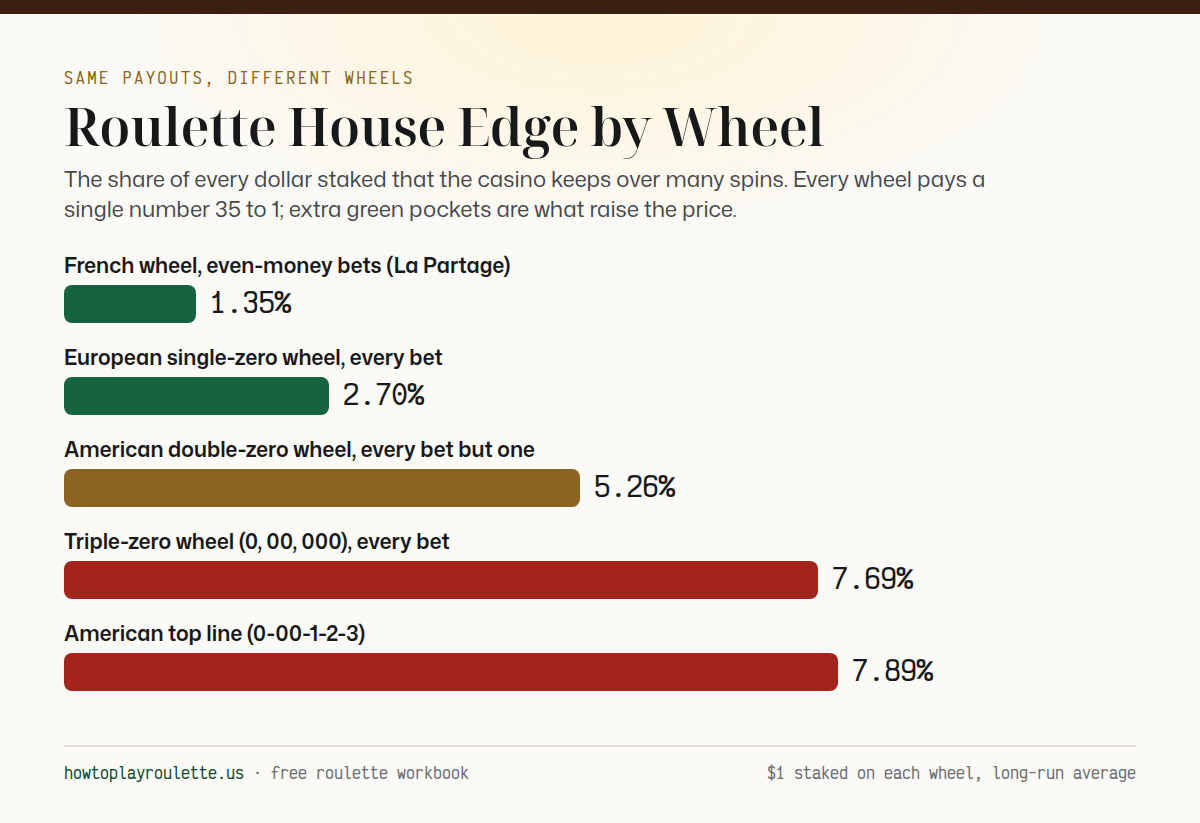
Here is the arithmetic. Put one chip on each of the 39 pockets and you have staked 39 chips. The winning number pays 35 to 1, so you get 36 chips back counting the original stake. You lose 3 chips of the 39, and 3 divided by 39 is 7.69%. That is the triple zero roulette house edge.
The same sum works for every bet. A dozen pays 2 to 1, returning 3 chips per winning chip. It wins 12 times in 39, so 3 times 12 is 36 back on 39 staked. Red pays 1 to 1 and wins 18 times in 39, and 2 times 18 is again 36. All roads lead to 36 of 39.
How 000 compares with double zero and single zero
The table below gives the standard wheels side by side. Read the house edge column and add one more line in your head: triple zero at 7.69% on every bet. On $100 wagered the average cost runs $2.70 on a single-zero wheel, $5.26 on a double-zero wheel and $7.69 on the triple zero wheel.
Chance per spin · house edge
| Bet | American | European | French |
|---|---|---|---|
| Straight up | 2.63% · 5.26% | 2.70% · 2.70% | 2.70% · 2.70% |
| Split | 5.26% · 5.26% | 5.41% · 2.70% | 5.41% · 2.70% |
| Street | 7.89% · 5.26% | 8.11% · 2.70% | 8.11% · 2.70% |
| Corner | 10.53% · 5.26% | 10.81% · 2.70% | 10.81% · 2.70% |
| Top line (0-00-1-2-3) | 13.16% · 7.89% | — | — |
| First four (0-1-2-3) | — | 10.81% · 2.70% | 10.81% · 2.70% |
| Six line | 15.79% · 5.26% | 16.22% · 2.70% | 16.22% · 2.70% |
| Dozen | 31.58% · 5.26% | 32.43% · 2.70% | 32.43% · 2.70% |
| Column | 31.58% · 5.26% | 32.43% · 2.70% | 32.43% · 2.70% |
| Red/black, odd/even, 1-18/19-36 | 47.37% · 5.26% | 48.65% · 2.70% | 48.65% · 1.35% |
Each cell shows the chance that the bet wins on one spin, then the share of every dollar wagered that the house keeps over time. A dash means the bet is not on that cloth.
From double zero to triple zero, the edge climbs by 2.43 percentage points. Divide 7.69 by 5.26 and you get about 1.46, so the same session costs roughly 46% more on average. Against a single-zero wheel the gap is wider still: 7.69 divided by 2.70 is about 2.85, close to three times the price.
What 000 Pays and Which Bets Change
A straight-up chip on 000 pays 35 to 1 with the same 1 in 39 chance as any number. Outside bets lose on 000 as on 0 and 00, because no green number belongs to a dozen, a column or a color. Bets that combine several zeros vary from table to table, so read the placard before using one.
Try one spin with numbers. You have $10 on 17, $10 on the second dozen and $10 on red, and the ball drops into 000. All three chips are swept, so the spin costs $30. Had it landed on 17, the straight pays $350 and the dozen $20, while red loses because 17 is black: a net gain of $360.
Pricing a roulette triple zero bet yourself
You can price any zero combination yourself with the same rule. If the table offers a split on 0 and 00 at the usual 17 to 1, it wins 2 times in 39 and returns 18 chips each time, 36 chips back for every 39 staked: 7.69% again. Anything returning less costs more.
On a standard American table the five-number top line on 0, 00, 1, 2 and 3 is already the most expensive bet at 7.89%. On a triple zero table almost every bet sits near that level. The regular bets on a 000 wheel cost about as much as the one bet that roulette guides usually tell you to avoid.
Where 000 Roulette Is Played and How It Started
The game is a Las Vegas invention. It first appeared around 2016 at the Venetian, where it was called Sands Roulette and the third green pocket carried a Sands logo rather than the digits 000. Within a few years many casinos on the Las Vegas Strip had added at least one 000 roulette table.
Those tables usually sit next to double-zero games rather than replacing them all, and the mix changes from casino to casino and year to year. Single-zero wheels are scarcer and often carry higher minimums. Rather than trusting any list, look at the wheel itself. Three green pockets, or a logo in the third, means a 7.69% game.
Why Casinos Add a Third Zero
From the casino’s side the logic is simple. A third zero lifts the average return to the house by about 46% compared with double zero, while the felt, the dealer and the payout card stay the same. Many players never count the green pockets, so the change rarely draws attention at the table.
For you, the effect shows up in how long a bankroll lasts. Take 60 bets of $10, a total of $600 wagered. The average loss on a triple zero wheel is 600 times 7.69%, about $46.15, against about $31.56 on double zero and $16.20 on single zero. The roulette strategy guide explains why no system closes that gap.
Should You Play Triple Zero Roulette?
The maths gives a plain answer: if a double-zero or single-zero table is open at a stake you can afford, sit there instead. No betting pattern changes the price, because every bet on a triple zero roulette table carries the same 7.69% edge. The American vs European roulette comparison shows how much the single-zero wheel saves.
If the only seat available is a 000 table, keep stakes small and skip combined zero bets you cannot price. Learn the game with how to play roulette, and if a single-zero table with French rules is nearby, its even-money bets cost 1.35%. Before you buy in, look at the head of the board and count the green boxes.