
Roulette Payouts Chart: What Every Chip Pays
Picture a $10 chip sitting alone on 17 when the ball drops into that pocket. The dealer leaves your chip where it is and slides $350 next to it, so $360 comes back to you. That single number is the top of the pay scale. Every other bet pays less because it covers more numbers.
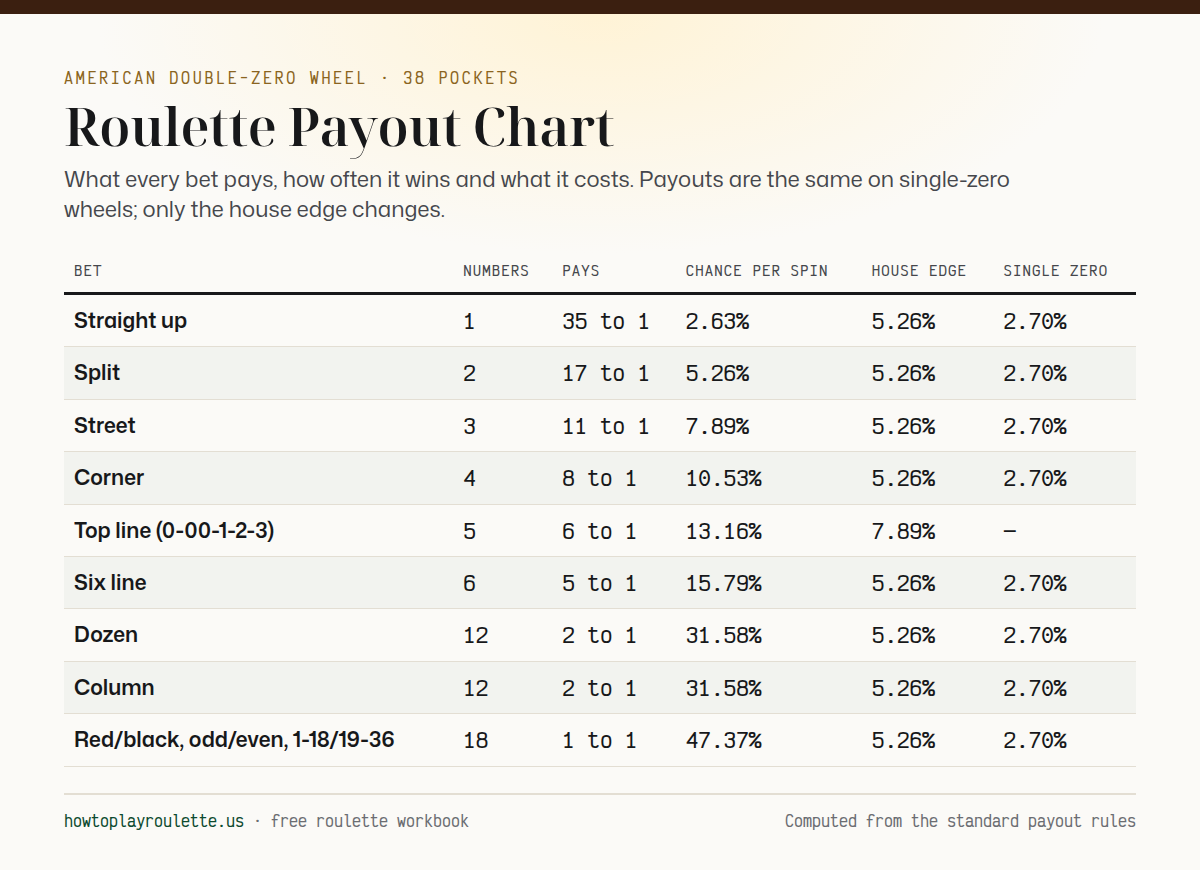
The roulette payout chart below lists every bet on the American double-zero layout, with the European price beside it. Read it from the top: the fewer numbers a bet covers, the bigger the payout. If the names of the bets are new to you, the guide to every roulette bet shows where each chip sits on the cloth.
Inside bets
Straight up · 1 number35 to 1
Split · 2 numbers17 to 1
Street · 3 numbers11 to 1
Corner · 4 numbers8 to 1
Top line (0-00-1-2-3) · 5 numbers6 to 1
Six line · 6 numbers5 to 1
Outside bets
Dozen · 12 numbers2 to 1
Column · 12 numbers2 to 1
Red/black, odd/even, 1-18/19-36 · 18 numbers1 to 1
Two columns matter most. The payout tells you what a winning chip earns on top of the stake, so 17 to 1 means seventeen chips plus your own one back. The coverage tells you how many pockets you hold. Multiply the two and add the stake, and you will notice the total almost always lands on 36.
That pattern is the quickest way to rebuild the roulette payout chart from memory when there is no card at the table. Divide 36 by the numbers covered, subtract one, and you have the price. Two numbers give 17 to 1, three give 11, four give 8, six give 5, twelve give 2, and eighteen give even money.
Roulette payouts explained at a US table
At most US casinos a sign at each roulette table shows the minimum and maximum bets, and some signs print the payouts. Read it before you sit down. The inside minimum usually applies to your total on the numbers, while each outside bet needs the full minimum on its own. If the card is unclear, ask the dealer.
The sign does not tell you what a chip is worth; you set that yourself. When you buy in, the dealer hands you wheel chips in a color nobody else at the table is using and marks their value. Every payment comes in those chips, so a 35 to 1 win means thirty-five of your color stacked beside the original.
Roulette bet payouts: inside and outside
Chips on the numbered grid are inside bets: straight up, split, street, corner, six line and the top line. Chips in the boxes around the grid are outside bets: dozens, columns, red, black, odd, even, low and high. The roulette table layout page labels every box, which helps when you are matching a chip to its price.
Every bet on the cloth
One chip in the middle of a single number, here 17.
- Covers
- 1 of 38
- Pays
- 35 to 1
- Wins per 100 spins
- 2.6
- House edge
- 5.26%
Outside bets win often and pay little. Inside bets win rarely and pay a lot. Neither group is cheaper on average, which surprises many new players. On an American wheel each one costs the same 5.26% of what you wager, with a single exception on the top line that the section on the worst bet covers below.
Payouts on roulette for one $5 chip
What are the payouts on roulette in plain dollars? The table turns each price into a single $5 chip, a common first stake for someone new to the game. The last column adds back your stake, because that is what you actually see pushed across the felt once the dealer finishes paying the winners.
| Bet | Numbers covered | Pays | A winning $5 chip wins | You collect |
|---|---|---|---|---|
| Straight up | 1 | 35 to 1 | $175 | $180 |
| Split | 2 | 17 to 1 | $85 | $90 |
| Street | 3 | 11 to 1 | $55 | $60 |
| Corner | 4 | 8 to 1 | $40 | $45 |
| Top line (0-00-1-2-3) | 5 | 6 to 1 | $30 | $35 |
| Six line | 6 | 5 to 1 | $25 | $30 |
| Dozen or column | 12 | 2 to 1 | $10 | $15 |
| Red, black, odd, even, low, high | 18 | 1 to 1 | $5 | $10 |
Notice how the right-hand column climbs. The straight-up chip turns $5 into $180, while the same chip on red turns into $10. Yet both bets cost the same on average, because the big payment arrives about once in 38 spins and the small one about 18 times in 38. Roulette payouts trade frequency for size, never value.
True Odds vs Payout Odds: Where the 5.26% Comes From
True odds describe how often a bet really loses compared with how often it wins. A single number on an American wheel has one winning pocket and 37 losing ones, so the true odds are 37 to 1. The casino pays 35 to 1. That two-chip gap, repeated on every spin, is the house edge.
Read the video script
What Nevada casinos kept from roulette
Share of the drop kept by every roulette table in Nevada, per calendar year, against the house edge of one American bet.
Dashed line: the house edge on one American bet, 5.26%. Lighter bar: 2020, with casinos closed for part of the year.
- Average 2014–2024
- 18.3%
- Kept in 2024
- $440M
- Tables, 2024 average
- 435
Show the figures
Run the arithmetic on a whole wheel. Put $1 on each of the 38 pockets, 0 and 00 included, and you have staked $38. Whatever number comes up, one chip wins $35 and keeps its own $1, so $36 comes back. You lose $2 out of every $38, and $2 divided by $38 is 5.26%.
The same sum works for any bet on the double-zero table. Eighteen chips on red, twenty on everything else: you return $36 from $38 of risk in the long run. Roulette payouts are set as if there were only 36 pockets, and the two green ones are the casino’s margin. That is roulette odds explained in one line.
The single-zero version
Take the zero away and the gap shrinks. A European wheel has 37 pockets, so $1 on each costs $37 and still returns $36. The loss is $1 in $37, or 2.70%. Same payouts, one fewer pocket, roughly half the price per spin. The American vs European roulette comparison follows that difference through a full session.
French tables go further on even-money bets. Under La Partage you get half your stake back on red, black, odd, even, high or low when the ball lands on zero, and En Prison holds the bet for one more spin instead. Either rule cuts the even-money edge to 1.35%, which the French roulette page explains with examples.
Atlantic City offers a double-zero cousin of La Partage. Under the New Jersey roulette payout rule, a casino may choose to take only half of each even-money wager when 0 or 00 comes up, and it must post that choice at the table. Those bets then cost 2.63% rather than 5.26%, while inside bets and dozens keep the American price.
Roulette Odds and Payouts for Every Bet, Wheel by Wheel
The table below gives the chance of winning each bet family on the American, European and French wheels, with the house edge beside it. These roulette odds come straight from counting pockets: the numbers a bet covers divided by 37 or 38. Nothing else goes into them. Read each row across to see what the second zero takes away.
Chance per spin · house edge
| Bet | American | European | French |
|---|---|---|---|
| Straight up | 2.63% · 5.26% | 2.70% · 2.70% | 2.70% · 2.70% |
| Split | 5.26% · 5.26% | 5.41% · 2.70% | 5.41% · 2.70% |
| Street | 7.89% · 5.26% | 8.11% · 2.70% | 8.11% · 2.70% |
| Corner | 10.53% · 5.26% | 10.81% · 2.70% | 10.81% · 2.70% |
| Top line (0-00-1-2-3) | 13.16% · 7.89% | — | — |
| First four (0-1-2-3) | — | 10.81% · 2.70% | 10.81% · 2.70% |
| Six line | 15.79% · 5.26% | 16.22% · 2.70% | 16.22% · 2.70% |
| Dozen | 31.58% · 5.26% | 32.43% · 2.70% | 32.43% · 2.70% |
| Column | 31.58% · 5.26% | 32.43% · 2.70% | 32.43% · 2.70% |
| Red/black, odd/even, 1-18/19-36 | 47.37% · 5.26% | 48.65% · 2.70% | 48.65% · 1.35% |
Each cell shows the chance that the bet wins on one spin, then the share of every dollar wagered that the house keeps over time. A dash means the bet is not on that cloth.
Look at the even-money row first. On a double-zero wheel red wins 47.37% of the time, on a single-zero wheel 48.65%. The difference looks small, yet it is the whole reason the edge doubles. The roulette wheel odds of a single number move only from 2.63% to 2.70%, while the payout stays at 35 to 1 in both cases.
Chance and edge are different questions. A dozen hits almost a third of the time, a straight-up number less than 3% of the time, and both cost you 5.26% on an American table. The bet you pick only changes how bumpy the ride feels. It does not change the average price of a spin.
What the percentages mean over a session
Expected loss is easy to work out. On an American wheel you lose $5.26 for every $100 you put through the game, whatever mix of bets you use. On a European wheel the figure is $2.70, and on French even-money bets with La Partage it is $1.35. Short sessions swing wildly around those averages; long ones drift towards them.
Spin it 1,000 times
Pick a bet. One chip goes on it every spin, on a fair American wheel with 38 pockets. Watch the running total.
- Spins
- 0
- Wins (expected)
- 0
- Chips up or down
- 0
- Longest losing run
- 0
Short runs swing both ways. Over many spins the line drifts toward the dashed one, the average loss the house edge sets, because every bet is paid as if the green pockets were not there.
Turnover, not your starting bankroll, drives the total. A player who bets $10 a spin for 200 spins has wagered $2,000, so the expected cost on a double-zero table is about $105. Halving the edge by finding a single-zero wheel saves more than any betting pattern could. That is the plain conclusion of the arithmetic.
Worked Roulette Payouts: $100 on Red, a $5 Split, a $25 Corner
Numbers on a chart become clearer with chips on the felt. The three examples below use the standard prices from the chart, with the stake counted separately, because players often mix up what a bet wins with what comes back. A dealer always pays the winnings and leaves the original chips on the layout.
$100 on red
Red pays 1 to 1. If the ball lands on any of the 18 red pockets, you win $100 and collect $200 including the original chips. If it lands on black, 0 or 00, you lose the $100. On an American wheel you win 18 spins in 38 on average, so the expected loss per bet is $5.26.
A $5 split
Put $5 on the line between 17 and 20 and you hold two numbers at 17 to 1. If either one hits, you win $85, and with your $5 returned you are handed $90. The chance per spin is 1 in 19 on a double-zero wheel. Over 19 spins you stake $95 and expect one win worth $90.
A $25 corner
A corner chip on the cross where 16, 17, 19 and 20 meet covers four numbers at 8 to 1. A win pays $200 and you collect $225 with the stake. It hits 10.53% of the time on an American table. Four numbers out of 38, a price set for 36: the same 5.26% again.
These roulette payouts also stack. Many players cover one number with several bets at once, and the winning spin then pays each bet separately. A straight-up chip on 17 plus a split on 17-20 both collect when 17 hits, while the split alone collects if 20 hits. The drill further down lets you practice exactly that.
The Top Line: the Worst Roulette Table Payout at 7.89%
One bet breaks the 36 rule. The top line, sometimes called the basket or five-number bet, covers 0, 00, 1, 2 and 3 on the American layout and pays 6 to 1. Fair pricing would be 36 divided by 5, minus one, which is 6.2 to 1. The casino rounds down, and you pay for the rounding.
Do the full-wheel test again. Imagine 38 spins with $1 on the top line each time. On average five of those spins win, and each win returns $7, stake included, for $35 back from $38. You lose $3 in $38, which is 7.89%. Every other roulette table payout on the same cloth costs 5.26%.
Single-zero tables have no top line. Their equivalent is the first four, covering 0, 1, 2 and 3 at 8 to 1, which keeps the standard 2.70% edge. If you want the green pockets on an American wheel, back them as a split or as two straight-up chips; the page on betting on green works through those options with numbers.
Roulette payouts on 0 and 00
Roulette payouts for 0 and 00 follow the same scale as every other number. A chip straight up on 0 pays 35 to 1, and so does a chip on 00. The two zeros side by side make a split at 17 to 1, and the trios 0-1-2, 0-00-2 and 00-2-3 pay 11 to 1, like a street.
What the zeros never do is pay an outside bet. When the ball drops into a green pocket, red and black lose, odd and even lose, and so do both halves, all three dozens and all three columns. A table full of even-money chips is cleared in one sweep, which is the moment the double zero earns its keep.
Roulette Payouts Calculator and Payout Drills
Mixed bets are where mental arithmetic slips. Place chips on the board below and the payout calculator adds up what each winning pocket would pay, with stake and winnings shown separately. It also works as a free roulette payout chart you can test against: change one chip, then predict the new total before the screen shows it.
Payout calculator
- Pays
- 17 to 1
- Win
- $255
- Back with stake
- $270
- Chance per spin
- 5.26%
- Average cost per spin
- $0.79
The average cost is the stake times the house edge for that wheel: what the bet loses per spin over thousands of spins, not on any single one.
A good habit is to pick a winning number before you look at the result. Count the straight-up chips on it, then the splits, streets and corners that include it, then the outside bets. If your total matches, you can trust yourself at a real table. For larger layouts the roulette payout calculator page has more room.
Use the roulette payouts calculator for the questions that come up at a table, such as how much a full picture on 17 returns or whether covering a whole street beats three single chips. Both answers fall out of the board in seconds, and both confirm the same rule: more chips change the size of a win, never its price.
The drill below gives you a finished layout and one winning pocket. Work out the payment before you reveal it. Three chips sit on the split 17-20 and two chips sit straight up on 17, and the ball has landed on 17. Count both bets, then check your answer against the card’s own calculation.
Payout drill
The ball drops into 17. On the cloth: 3 chips on split 17-20 and 2 chips on straight up on 17. How many chips does the dealer pay out, not counting the stakes that stay in place?
split 17-20: 3 × 17 = 51. straight up on 17: 2 × 35 = 70. Payout: 121 chips.
The second drill mixes inside and outside chips. Four chips cover the six line from 16 to 21, five sit on the corner 16-17-19-20, and two sit on the second dozen. The ball has landed on 19, so all three bets win. Work out each payment on its own first, then add them together before you check.
Payout drill
The ball drops into 19. On the cloth: 4 chips on six line 16-17-18-19-20-21, 5 chips on corner 16-17-19-20 and 2 chips on second dozen. How many chips does the dealer pay out, not counting the stakes that stay in place?
six line 16-17-18-19-20-21: 4 × 5 = 20. corner 16-17-19-20: 5 × 8 = 40. second dozen: 2 × 2 = 4. Payout: 64 chips.
How Dealers Count Roulette Table Payouts
After the ball settles, the dealer places a marker, often called the dolly, on the winning number. Losing chips are swept off the layout first. Then the winners are paid, usually the outside bets before the inside ones, while the marker stays put so nobody can add a chip late. Wait until the marker is lifted before betting again.
One thing catches new players out. Your winning chips stay on the layout after the payment, and if you leave them there they ride on the next spin. Pick up whatever you do not want to bet again as soon as the marker comes off. Payouts on roulette are pushed toward you, but the original stake is yours to move.
Each player buys in with their own color of wheel chips, which is how the dealer tells many stacks apart on a crowded layout. Payments are cut from the chip rack in columns and pushed to the winner. On the Las Vegas Strip and in Atlantic City you will usually see the same routine, regulated by the state gaming boards.
Picture bets
Dealers learn common chip patterns around a single number as fixed totals, so they do not add each chip one by one. These patterns are called picture bets. A number with one straight-up chip and four splits around it, for example, pays 35 plus 4 times 17, which is 103 chips. The dealer simply knows the picture.
You can build your own pictures in the same way. Number 17 has four splits: 14-17, 16-17, 17-18 and 17-20. It sits in four corners, one street and two six lines. One chip on each of those inside bets, plus the straight-up chip, pays 35, 68, 32, 11 and 10, for 156 chips in all.
Knowing a few totals lets you check a payment before the next spin starts, which is the only sensible time to raise a question. Count while the dealer cuts the chips. If something looks short, say so before the marker comes off. Once new bets are down, the previous layout is gone and nobody can rebuild it.
Do Roulette Payouts Change from Wheel to Wheel?
Standard roulette payouts are the same on every wheel: 35 to 1 for a number, 17 to 1 for a split, down to even money. The pocket count is what changes. A single-zero wheel costs 2.70%, a double-zero wheel 5.26%, and a triple-zero wheel adds a third green pocket at the same payouts, which makes it the dearest.
Wheel makers such as TCS John Huxley and Cammegh build both single- and double-zero wheels, so the pocket count comes from the casino’s choice, not the hardware. Monte Carlo is the classic home of the single zero, and US floors mostly run double-zero tables. Nevada and New Jersey regulators approve the games, but the arithmetic is the same everywhere.
No staking plan alters these prices. Doubling after a loss, as in the Martingale system, changes how often you win small and lose big, never the 5.26% average. The roulette strategy guide tests that with simulations. If the table card says single zero, take that seat; if it shows a 00, read the green before you buy in.