
The best roulette strategy starts with the wheel you sit down at
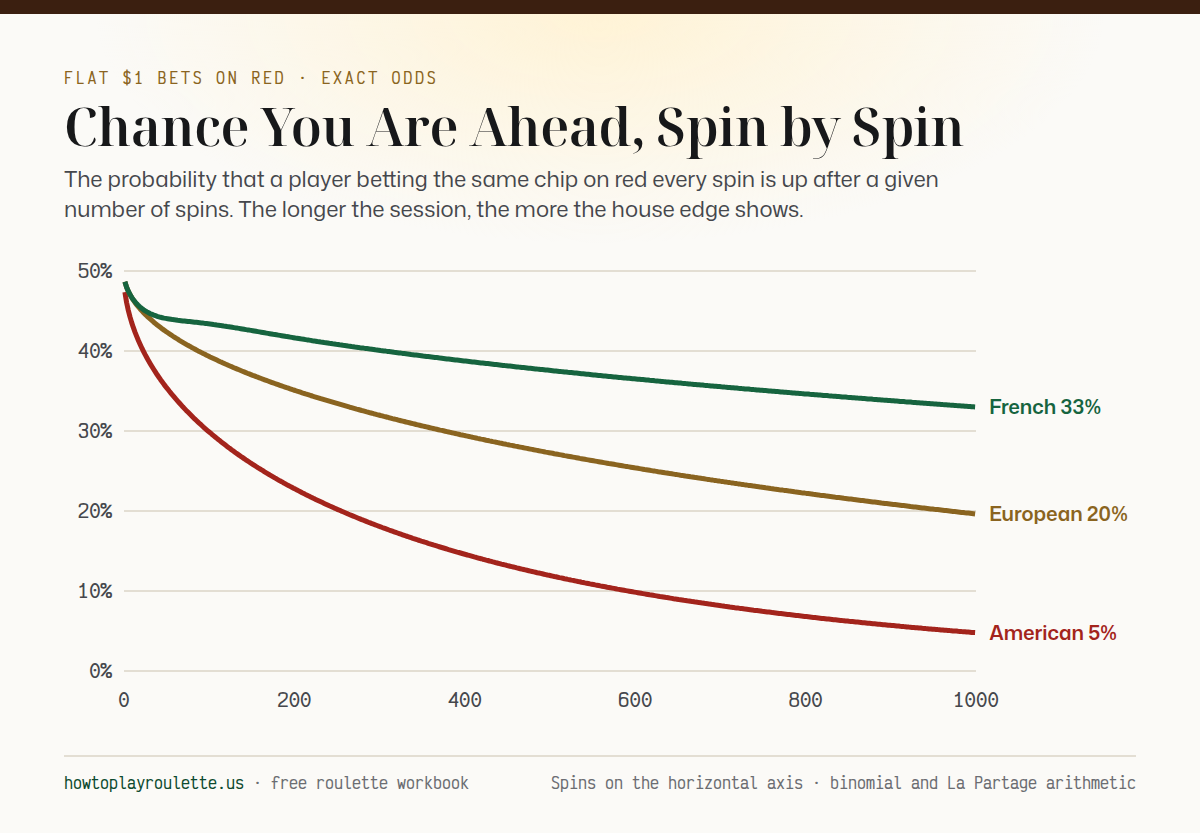
Before any system, look at the wheel. An American table has 38 pockets including 0 and 00, while a European or French wheel has 37 with a single zero. Payouts are identical on both: 35 to 1 on a single number, 1 to 1 on red. The extra green pocket is the whole difference, and it doubles your cost.
Here is the arithmetic. On an American wheel 36 of every 38 units wagered come back on average, so you lose 2 of 38, which is 5.26%. On a single-zero wheel you lose 1 of 37, or 2.70%. Put $1,000 through each and the expected loss is $52.60 against $27.00. That gap dwarfs anything a betting pattern can do.
So the best roulette strategy, in plain terms, is to find a single-zero table and play it. On the Las Vegas Strip and in Atlantic City double-zero wheels are the norm, and single-zero tables, where they exist, often carry higher minimums. The full comparison sits in American vs European roulette, including how to tell the two layouts apart.
French rules go one step further. With La Partage, an even-money bet that loses to zero returns half its stake, which drops the edge on red, black, odd, even, low and high to 1.35%. That makes it the cheapest roulette betting strategy you can follow without counting anything. You can read how the rule works on the French roulette page.
One trap to avoid. Some casinos have tried a triple-zero wheel with 0, 00 and a third green pocket, and the payouts stay exactly the same. Three green pockets out of 39 push the cost even higher than the American wheel. If you ever see one, the triple-zero roulette breakdown shows why walking past it is the smart move.
How roulette strategy meets the house edge, bet by bet
Every roulette strategy is a way of combining bets, so start with what each bet costs on its own. The table below computes the chance and house edge for each bet family on the three wheel types. Read across a row and notice that the chance changes with the bet while the edge, on any given wheel, barely moves.
Chance per spin · house edge
| Bet | American | European | French |
|---|---|---|---|
| Straight up | 2.63% · 5.26% | 2.70% · 2.70% | 2.70% · 2.70% |
| Split | 5.26% · 5.26% | 5.41% · 2.70% | 5.41% · 2.70% |
| Street | 7.89% · 5.26% | 8.11% · 2.70% | 8.11% · 2.70% |
| Corner | 10.53% · 5.26% | 10.81% · 2.70% | 10.81% · 2.70% |
| Top line (0-00-1-2-3) | 13.16% · 7.89% | — | — |
| First four (0-1-2-3) | — | 10.81% · 2.70% | 10.81% · 2.70% |
| Six line | 15.79% · 5.26% | 16.22% · 2.70% | 16.22% · 2.70% |
| Dozen | 31.58% · 5.26% | 32.43% · 2.70% | 32.43% · 2.70% |
| Column | 31.58% · 5.26% | 32.43% · 2.70% | 32.43% · 2.70% |
| Red/black, odd/even, 1-18/19-36 | 47.37% · 5.26% | 48.65% · 2.70% | 48.65% · 1.35% |
Each cell shows the chance that the bet wins on one spin, then the share of every dollar wagered that the house keeps over time. A dash means the bet is not on that cloth.
Look at the American column first. A straight-up bet wins 2.63% of the time and a red bet 47.37% of the time, yet both cost exactly 5.26%. Only the five-number top line, covering 0, 00, 1, 2 and 3, is worse at 7.89%. On the single-zero wheel every bet sits at 2.70%, apart from the French even-money bets at 1.35%.
That flat line is why the best roulette strategy is about cost. Because each bet carries the same edge, mixing, sequencing or sizing them by past results cannot change the average. A system only reshapes the distribution of outcomes. It can make small wins frequent and big losses rare, or the other way round. It never moves the center.
So what is left for a player? Four things: which wheel you play, how big each bet is, how long you play and how volatile your bets are. A long session of single numbers swings wildly; a long session of red barely moves. If you want the exact returns on each chip, the roulette payouts chart lays them out.
A roulette strategy chart: every system on one page
Here is the field in one table, priced on an American wheel with even-money bets unless noted. Read the third column as the feel of a typical session and the last column as the bill. If you were hoping one row would show a smaller number than the others, that is the point: none does, whatever the system’s name.
| System | What you do | Typical session | Cost per $100 wagered |
|---|---|---|---|
| Flat betting | Same stake every spin | Slow, steady drift | $5.26 |
| Martingale | Double after a loss | Many small wins, rare big loss | $5.26 |
| Paroli | Double after a win, bank after three | Many small losses, rare big win | $5.26 |
| Fibonacci | Step up the sequence after a loss | Slower climb than doubling | $5.26 |
| D’Alembert | One unit up after a loss, one down after a win | Smallest swings of the progressions | $5.26 |
| Labouchere | Bet first plus last number of a written line | Line grows fast in a losing run | $5.26 |
| James Bond | 200 units spread over 25 pockets | Wins about two spins in three | $5.26 |
| Two dozens | Equal stakes on two dozens | Wins about 63% of spins | $5.26 |
So which is the best roulette betting strategy? On cost alone it is a tie, and the tie breaks only when you change the wheel: every figure in the last column falls to $2.70 on a single-zero table, and the even-money rows to $1.35 with La Partage. The most profitable roulette strategy, in practice, is whichever one wastes least.
Progressive roulette strategies: Martingale and Paroli
Progressive systems change your stake depending on the last result. They are the most popular roulette strategies by far, because they turn a dull game of even-money bets into a story with a goal. The two classics run in opposite directions: one doubles after a loss, the other doubles after a win. Neither touches the edge.
Martingale: double after every loss
The Martingale, the classic double-up plan, is the roulette betting system people search for most. You bet one unit on red; if it loses, you double; when it finally wins, you are up one unit and start again. It feels unbeatable because most cycles end in a small profit. The detailed walkthrough lives on the Martingale page.
Read the video script
The trouble is the streak. A red bet on an American wheel loses 20 times in 38: black and both greens. Seven losses in a row has a chance of (20/38) to the seventh power, about 1.1%, or roughly 1 in 89 cycles. Starting at $5, those seven losses cost $635, and the eighth bet needs $640.
Most players run many cycles in a night, so a one-in-89 event is not rare at all. And there is a hard wall besides your wallet. Every table posts a maximum bet, and a doubling sequence that starts at the table minimum hits it within a handful of losses. Once you cannot double, the system has no answer left.
Try it: a roulette strategy simulator for a thousand doubling players
The simulation below runs a doubling system on red for 1,000 players at the American table. Set a starting bankroll, base bet, session length and table maximum, then watch how many players run out of room before their spins are up. Start with the default settings, then change one thing at a time and see which change really matters.
Doubling system: 1,000 players
Each player starts with the bankroll below, bets the base stake on red, doubles after every losing spin and drops back to the base after a win. A player is out when the next stake is bigger than what is left or than the table maximum.
- Went bust or hit the limit
- —
- Finished ahead
- —
- Stopped by the table maximum
- —
The spins are random every run, so the counts move a little each time. The house edge does not: every dollar staked still loses its share on average.
Run it with the starting settings and look at the split. Roughly nine players in ten meet a losing streak that pushes the next doubled bet past the $500 table maximum, and only about one in ten walks away ahead. Shorten the session to 50 spins and the picture flips. The house edge simply waits.
Raise the bankroll to $2,000 and run again. Almost nothing changes, because the wall is the $500 maximum: from a $10 start the bets run 10, 20, 40, 80, 160 and 320, and a seventh bet of $640 is not allowed. Six misses in a row is about a 2.1% event, and a 200-spin session offers it dozens of chances.
A smaller base bet helps a little. Drop it to $5 and the sequence gains one more doubling before the limit, yet about two players in three still bust over 200 spins. The lesson the simulator keeps repeating is that the table maximum, not your wallet, decides how far a doubling system can run.
Paroli roulette strategy: the reverse Martingale
The Paroli flips the idea. You double after a win, usually for three wins, then bank the profit and return to one unit. Losses only ever cost a single base stake, so the downside per cycle is small. The catch is that three straight wins on red happen only about 11% of the time on an American wheel.
That figure comes from 18 out of 38, about 0.4737, cubed, which gives roughly 0.106. So nine cycles in ten end in a one-unit loss, and one in ten pays seven units. It is a calmer ride than Martingale and a reasonable roulette system for anyone who prefers slow losses to sudden ones. The average result does not move.
Fibonacci, D’Alembert and Labouchere: slower roulette systems
If doubling feels too steep, three older systems promise a gentler climb. All three are negative progressions, raising the stake after a loss, so they share the Martingale’s basic flaw at a slower pace. They are worth knowing because each one appears in almost every list of roulette strategies, often with claims they cannot support.
Fibonacci roulette strategy
The Fibonacci system uses the sequence 1, 1, 2, 3, 5, 8, 13, 21, where each number is the sum of the two before it. You move one step forward after a loss and two steps back after a win. Ten straight losses mean a tenth bet of 55 units and 143 units lost in total.
That sounds slower than doubling, and it is. But slower is not safer in the long run, only slower to arrive. Because a single win steps you back only two places, a choppy session can leave you deep in the sequence and well behind, even with plenty of winning spins. The edge on each individual bet is still 5.26%.
D’Alembert
The D’Alembert system adds one unit after a loss and removes one after a win. It is named after the French mathematician Jean le Rond d’Alembert, who believed outcomes should balance out over time. They do not, at least not in the way the system needs. A wheel has no memory of the last ten spins.
Of all the negative progressions the D’Alembert produces the smallest swings, which is why it often gets called a roulette strategy that works. What it really does is lose slowly. On equal numbers of wins and losses you end up ahead by one unit per win, but the wheel hands out fewer wins than losses, every session, on average.
Labouchere
The Labouchere, or cancellation system, starts with a written line of numbers such as 1, 2, 3, 4. Each bet is the sum of the first and last numbers. Win, and you cross both off; lose, and you add the amount you lost to the end. When the line is empty, you have won its total, here ten units.
It feels like progress because you are crossing things off. In practice a losing run lengthens the line quickly, and the bets grow toward the table maximum just as they do under Martingale. Try the line on paper with an honest list of reds and blacks, including a few green pockets, and the problem shows up within a page.
The James Bond roulette strategy and other fixed spreads
Not every roulette system changes stakes. Some spread one fixed amount across the layout so that most spins pay something. The best known is the James Bond strategy, named after the novels, with a total of 200 units on each spin. It is a good example of why covering more pockets does not mean losing less.
Here is the spread: 140 units on high (19 to 36), 50 on the six line 13 to 18, and 10 on zero. If high wins you collect 140 and lose 60, a net of 80. The six line pays 5 to 1, so 250 minus 150 is 100. Zero pays 35 to 1: 350 minus 190 is 160.
| Result | Pockets on an American wheel | Net result on 200 units |
|---|---|---|
| 19 to 36 | 18 | +80 |
| 13 to 18 | 6 | +100 |
| 0 | 1 | +160 |
| 1 to 12 or 00 | 13 | -200 |
On an American wheel that covers 25 of 38 pockets, so you win about two spins in three. The other 13 pockets cost the full 200 units. Multiply it out and every bet in the spread still carries 5.26%, so the expected loss is about 10.53 units per spin. Frequent wins, same price.
That is the honest pattern with every spread. More coverage means more frequent small wins and occasional larger losses, while fewer chips means rare big wins and frequent small losses. Neither is better in expectation. Pick whichever rhythm you enjoy, keep the total stake small and treat the spread as entertainment, which is what it is.
Roulette dozens and columns strategy: two thirds of the table
A simpler spread puts equal stakes on two dozens. Take $10 on the first dozen and $10 on the second. If either one hits, that dozen pays 2 to 1, so you collect $20 and keep that $10 while the other $10 is lost: a $10 profit. Any of the remaining 14 pockets costs both chips.
Payout drill
The ball drops into 7. On the cloth: 5 chips on first dozen and 5 chips on second dozen. How many chips does the dealer pay out, not counting the stakes that stay in place?
first dozen: 5 × 2 = 10. second dozen loses 5. The dealer takes 5 losing chips first. Payout: 10 chips.
On an American wheel that is 24 winning pockets out of 38, about 63% of spins. The arithmetic of the average: 24 times $10 won minus 14 times $20 lost is minus $40 over 38 spins, or about $1.05 per $20 spin, which is 5.26% again. Two columns work exactly the same way.
Spreads with names like double street quad, which mix six lines, a corner and single numbers, follow the same rule. Each piece is priced at 5.26%, so the blend is too. These patterns look impressive over twenty spins because the win rate is high, and twenty spins is exactly where the losing pockets can hide for a while.
Flat betting, hot numbers and the gambler’s fallacy
The plainest roulette betting strategy is flat betting: the same stake on every spin, whatever happened last. It has no clever name and no story, so few guides praise it. Yet it is the approach that keeps your losses closest to the expected figure and your bankroll alive the longest. Boring, and good.
Flat betting over 1,000 spins
Pick a bet. One chip goes on it every spin, on a fair American wheel with 38 pockets. Watch the running total.
- Spins
- 0
- Wins (expected)
- 0
- Chips up or down
- 0
- Longest losing run
- 0
Short runs swing both ways. Over many spins the line drifts toward the dashed one, the average loss the house edge sets, because every bet is paid as if the green pockets were not there.
Flat betting also makes costs predictable. Thirty spins an hour at $10 on red is $300 wagered, so the average hourly cost on an American wheel is about $15.79, worked out as $300 times 5.26%. On a single-zero wheel the same hour costs about $8.11. That is a number you can budget for in advance, unlike any progression.
Now the most stubborn myth at the table: the idea that a color or number is due. The commonly told story from Monte Carlo in 1913, when black reportedly came up 26 times in a row, is the classic illustration. Players bet heavily on red as the streak grew and lost fortunes. The wheel was not tracking anything.
That error is the gambler’s fallacy, and it cuts both ways. Some players chase a cold number because it is overdue; others back a hot number because it is on a run. Both read meaning into noise. On a fair American wheel every pocket has the same 1 in 38 chance on every spin, no matter what the scoreboard shows.
The electronic boards above many tables show the last dozen results. They are there because players enjoy reading patterns into them. Twelve spins is a tiny sample. In any short run some numbers will repeat and others will vanish, simply by chance. To see it for yourself, the free roulette table lets you spin without staking anything.
Wheel bias, rigged wheels and what history really shows
There is one real exception in roulette history, and it has nothing to do with betting patterns. Old wheels could develop a physical bias, from a worn pocket, a loose fret or a slightly tilted bowl, and a few patient players are reported to have tracked thousands of spins to find one. That was mechanical, not mathematical.
Modern casino wheels from makers such as TCS John Huxley and Cammegh are built to reduce that, with low-profile pocket separators and precision bearings. Casinos level and inspect wheels, rotate them between tables and log results. In regulated US markets, bodies such as the Nevada Gaming Control Board and the New Jersey Division of Gaming Enforcement oversee table game equipment.
Could a wheel be rigged against you? In a licensed casino it is very unlikely, and it would also be unnecessary, since the green pockets already guarantee the house its margin over time. The full answer, covering both land-based and online play, is on is roulette rigged. The short version is that the edge does the work quietly.
Electronic roulette raises the same question. Some terminals take bets on a real wheel spun nearby, others draw results from a random number generator, and in regulated US markets both are tested and approved before they reach the floor. No electronic roulette strategy gets around either, because the green pockets carry the same edge as at a live table.
So why do bias stories survive? Because they are true in a narrow sense and appealing in a broad one. A biased wheel once existed, so maybe this one is biased too. Tracking a few hundred spins proves nothing, though. You would need many thousands of spins on one wheel to separate a real bias from normal randomness.
Roulette strategy for a small bankroll: $20 and $100 worked out
The best roulette strategy with $100 is to turn it into units and keep each bet to one of them. If the posted minimum allows $5 bets, twenty units on an even-money chance give you a long session: sixty spins put $300 through the wheel, an expected cost of about $15.79, or $8.11 on a single zero.
Compare that with doubling. Starting at $5, a $100 bankroll survives only four losses in a row: $5, $10, $20 and $40 leave $25, which cannot cover the next $80 bet. Set the simulator above to a $100 bankroll, a $5 base bet and 60 spins, and about eight players in ten go bust before the session ends.
With $20, the sign at the table edge decides the plan. At a $5 minimum you have four bets: four flat spins on red or a dozen, and an early night. Doubling from $5 stalls after two misses, which leave $5 against a $20 bet, and two straight misses on red happen about 28% of the time.
For a simple roulette strategy to carry to the table, remember units, spins and a stop: fifty units in the bankroll, one unit per spin, and a stop at half the bankroll lost. That basic plan is dull on paper and easy to keep after a drink. New to the rules themselves? Start with how to play roulette first.
How to win at roulette as often as the maths allows
If no system beats the edge, how to win at roulette has a modest answer: accept that wins are short-term luck and plan to keep them. The best way to play roulette is a set of decisions made before you sit down, about the wheel, the stake, the session and the risk.
What Nevada casinos kept from roulette
Share of the drop kept by every roulette table in Nevada, per calendar year, against the house edge of one American bet.
Dashed line: the house edge on one American bet, 5.26%. Lighter bar: 2020, with casinos closed for part of the year.
- Average 2014–2024
- 18.3%
- Kept in 2024
- $440M
- Tables, 2024 average
- 435
Show the figures
Choose your bet volatility on purpose
Even-money bets win nearly half the time and keep a bankroll steady. Dozens and columns pay 2 to 1 and win about a third of the time. Single numbers pay 35 to 1 and win once in 38 spins on average. All cost the same on one wheel, so choose by how much swing you want, not by expected value.
If you want to know how to play roulette and win a session, low volatility gives you more sessions that end close to even, while high volatility gives you more big wins and more early exits. Your roulette bets mix is the dial. Most players do well with mostly outside bets and a single number for fun.
Size bets to the session, not the dream
The best strategy for roulette sizing is to divide your session money into many units, often fifty or more, and keep each bet at one or two of them. That gives you enough spins to enjoy the game and ride out normal losing runs. Raising stakes to recover losses is how a planned evening turns into an expensive one.
Set two numbers before the first spin: a loss limit and a win target. When either is reached, stand up. A win target turns a lucky streak into a result you actually keep. Play within limits you set while calm, and if roulette stops being fun, call 1-800-GAMBLER for free, confidential help any time.
Practice first, then decide
The cheapest way to test a roulette strategy is to run it without money. Spin a practice table for a few hundred rounds at your planned stake and stop rules, and note where you would have quit. You will learn more about how to win at roulette, and how sessions really end, from that list than from any system’s promise.
The roulette tips page collects smaller table habits, from reading the posted minimum to knowing when the dealer calls no more bets. One last check before you buy in: look for the little placard at the table edge. It tells you the minimum, the maximum and, crucially, whether the wheel has one green pocket or two.