

What Is Roulette? The Wheel, the Cloth and the Dealer
What is roulette, in one line? It is a casino game in which you bet on the numbered pocket a small ball will land in, and the house pays a fixed price on every winning chip. That is the whole game. Everything else, from the chips to the dealer’s hand signals, exists to make that bet quick to settle.
The wheel is the first piece. An American wheel is a heavy bowl with a spinning center, the rotor, cut into 38 numbered pockets: 1 to 36 plus a green 0 and a green 00. Around the rim runs a sloped track where the ball circles, and small metal deflectors break its fall so it bounces unpredictably.
The cloth, which some players call the roulette board, is where the money goes. It is a printed felt layout of the same 38 numbers in counting order, three columns of twelve, with the zeros at the head and boxes for the larger bets around the edge. You never touch the wheel. Every decision you make happens on that cloth.
The dealer runs both. At a US casino one dealer usually spins the wheel, closes the betting, marks the result, sweeps the losing chips and pays every winner, sometimes with a second dealer on a crowded table, and also sells you chips. Players never handle the ball, so the only skill involved is reading the cloth correctly.
The round ties the three together. Betting opens, chips go down, the ball is spun, betting closes, the ball drops and the winning number is marked. That cycle repeats all day. The roulette game you see in a film and the one at a table in Las Vegas or Atlantic City follow the same loop.
Why does the house come out ahead? Each payout sits slightly below what the odds justify. A single number has 1 chance in 38, so a fair price would be 37 to 1, yet the table pays 35 to 1. That gap, repeated on every bet, is the house edge.
How Does Roulette Work? The Round in Five Steps
Start with the practice table above. Pick a lesson, drop chips where it tells you, press spin and watch the payout line fill in; the lessons run from outside bets to the zeros, then payout drills and a doubling test. Everything below explains what you just did and why each chip paid what it paid.
So how does roulette work once real chips are involved? Every round follows the same five steps. Betting opens and players place chips. The dealer spins the wheel and launches the ball against the spin. The dealer calls no more bets. The ball drops into a pocket. Then the dealer marks that number, collects losing chips and pays winners.
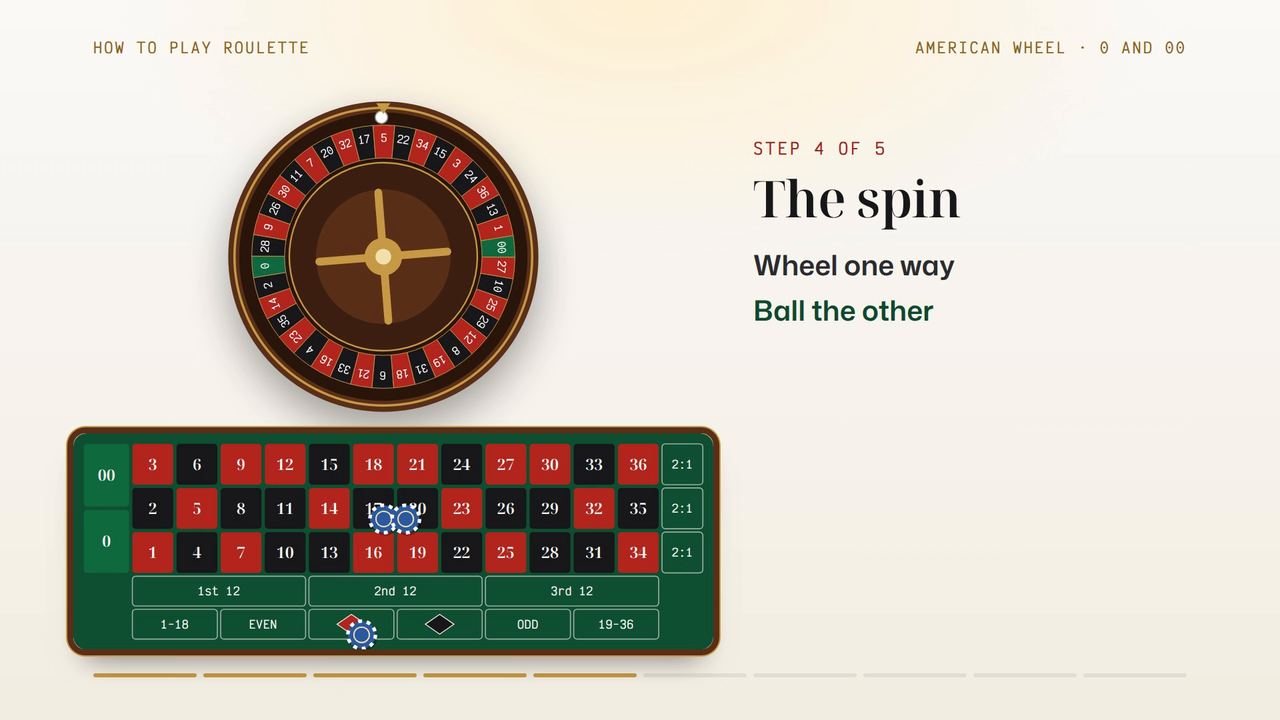
Read the video script
The short answer to “how does roulette work” is that loop. There is no hand to play and no decision once the ball is moving. The only choices you make are where your chips go and how many you place, which is why learning the layout and the payouts gets you almost all the way there.
The wheel and the ball move in opposite directions on purpose. The rotor turns one way while the ball travels the outer track the other way, until friction slows it and it falls across the deflectors into the pockets. That bounce is the reason casinos treat each spin as independent: the last number tells you nothing about the next.
Independence is the part that trips people up. The wheel has no memory, so after five reds in a row the chance of red on the next spin is still 18 in 38. Results boards make streaks look meaningful, but they only record history. If you have wondered whether roulette is rigged, that page covers how wheels are tested.
What the dealer does between spins
A dealer at an American table handles chips, the wheel and the payouts alone, often for a full table. After the result is marked, the losing chips are swept off first, then each winning bet is paid in turn, starting with outside bets. Wait for that to finish. Reaching for chips early is the most common beginner mistake.
The order matters to you as a player. Outside bets are usually paid first because they sit closest to the dealer and are quick to count, then the inside bets on the grid. A winning straight-up chip is often paid with a stack pushed next to it. Pick that stack up, and decide separately whether the original chip rides again.
How to Bet on Roulette: Inside Bets, Outside Bets and What They Pay
The quickest answer to how to bet on roulette is to split the layout in two. Inside bets sit on the number grid itself and cover one to six numbers. Outside bets sit in the boxes around it and cover twelve or eighteen numbers. Inside bets pay more; outside bets win more often, and both cost the same on average.
Inside bets
A straight-up bet on one number pays 35 to 1. A split on two neighboring numbers pays 17 to 1, a street across a row of three pays 11 to 1, and a corner on four numbers pays 8 to 1. The six line pays 5 to 1. The American cloth adds the five-number top line at 6 to 1.
Outside bets
Red or black, odd or even, and low (1-18) or high (19-36) each cover 18 numbers and pay 1 to 1. A dozen or a column covers 12 numbers and pays 2 to 1. None of these boxes include 0 or 00, so when green comes up every outside bet on the table loses at once, whatever else happened.
Which side should a beginner use? On an American wheel both cost the same, so the choice is about how you want the session to feel. Outside bets win close to half the time and keep your stack steady. Inside bets lose most spins, then pay a large sum at once. Mixing the two is common.
Every bet on the cloth
One chip in the middle of a single number, here 17.
- Covers
- 1 of 38
- Pays
- 35 to 1
- Wins per 100 spins
- 2.6
- House edge
- 5.26%
The chart below lists every bet with its payout, the numbers it covers and its chance on each wheel. Read across a row rather than down a column. A $10 straight-up win returns $360, your $10 plus 35 times it, while the same chip on red returns $20. The chart is the reference sheet the drills on this page use.
Inside bets
Straight up · 1 number35 to 1
Split · 2 numbers17 to 1
Street · 3 numbers11 to 1
Corner · 4 numbers8 to 1
Top line (0-00-1-2-3) · 5 numbers6 to 1
Six line · 6 numbers5 to 1
Outside bets
Dozen · 12 numbers2 to 1
Column · 12 numbers2 to 1
Red/black, odd/even, 1-18/19-36 · 18 numbers1 to 1
Notice what the chart does not show: a bet that pays more than its fair share. If 38 pockets were paid fairly, a single number would return 37 to 1. The house pays 35, and that gap is built into every row. You can read the full reasoning, bet by bet, on the roulette payouts and odds page.
Try a payout drill
Here is how to bet on roulette and check it in one round. Two chips sit on 17 straight up, three on the 17-20 split, four on the second dozen and ten on red. The ball lands on 17, which is black. Add up each winning bet, subtract the losing chips, then open the card to check your total.
Payout drill
The ball drops into 17. On the cloth: 2 chips on straight up on 17, 3 chips on split 17-20, 4 chips on second dozen and 10 chips on red. How many chips does the dealer pay out, not counting the stakes that stay in place?
straight up on 17: 2 × 35 = 70. split 17-20: 3 × 17 = 51. second dozen: 4 × 2 = 8. red loses 10. The dealer takes 10 losing chips first. Payout: 129 chips.
The usual slip is counting the stake as part of the win. A payout of 35 to 1 means 35 chips of profit, with your original chip returned on top. Dealers pay the profit and leave the winning chip where it stood, so it rides again unless you move it. More examples sit on the guide to every roulette bet.
Roulette Odds in Plain Numbers: Chance per Spin Against the Payout
What are the odds in roulette? Two numbers describe every bet: how often it wins and what it pays when it does. On an American wheel a single number wins 1 time in 38, or 2.63% of spins, and pays 35 to 1. Red wins 18 times in 38, or 47.37%, and pays 1 to 1.
Is roulette 50/50? No, and the reason is green. Red, black, odd, even, low and high each cover 18 numbers, but the wheel has 38 pockets. The two zeros belong to none of those bets, so an even-money chip wins 47.37% of the time and loses 52.63%. That gap is small per spin and steady over hundreds.
Spin it 1,000 times
Pick a bet. One chip goes on it every spin, on a fair American wheel with 38 pockets. Watch the running total.
- Spins
- 0
- Wins (expected)
- 0
- Chips up or down
- 0
- Longest losing run
- 0
Short runs swing both ways. Over many spins the line drifts toward the dashed one, the average loss the house edge sets, because every bet is paid as if the green pockets were not there.
What is the payout on roulette, bet by bet? The table below answers it for the American wheel, the default in US casinos. Read each row as a trade: fewer numbers, fewer wins, a bigger payout. The figures match the payout chart above, laid out here so the chance sits next to the price.
| Bet | Numbers covered | Pays | Chance per spin (American) |
|---|---|---|---|
| Straight up | 1 | 35 to 1 | 2.63% (1 in 38) |
| Split | 2 | 17 to 1 | 5.26% (1 in 19) |
| Street or trio | 3 | 11 to 1 | 7.89% (1 in 12.67) |
| Corner | 4 | 8 to 1 | 10.53% (1 in 9.50) |
| Top line (0-00-1-2-3) | 5 | 6 to 1 | 13.16% (1 in 7.60) |
| Six line | 6 | 5 to 1 | 15.79% (1 in 6.33) |
| Dozen or column | 12 | 2 to 1 | 31.58% (1 in 3.17) |
| Red/black, odd/even, low/high | 18 | 1 to 1 | 47.37% (1 in 2.11) |
Look at how payout and chance move together. A corner covers 4 numbers and pays 8 to 1; a split covers 2 and pays 17 to 1. Every payout follows one rule: 36 divided by the numbers covered, minus the returned stake. The top line breaks the pattern: 36 divided by 5 is 7.2, yet it pays 6.
A worked $100 example
Here is the house edge in dollars. Bet $100 on red for 38 spins, and assume the ball lands exactly as the odds say: 18 reds, 18 blacks and 2 greens. You wager $3,800 in total. Each of the 18 wins returns $200, your stake plus $100, for $3,600. The 20 losses return nothing, so you finish $200 down.
Now put the same $100 on number 17 for 38 spins. It hits once on average and returns $3,600, the $100 stake plus 35 times it. The 37 misses return nothing. Again you wager $3,800 and get $3,600 back. Divide the $200 shortfall by $3,800 and you get 5.26%, the same cost as red on a very different ride.
Try a dozen and the answer repeats: 12 wins in 38 spins, each returning $300, make $3,600. Every American bet lands on that $3,600 except the top line, where 5 wins at $700 each return $3,500 and the shortfall grows to $300, or 7.89%. To test your own chip combinations, the roulette payout calculator adds them up for you.
The practical lesson is short. On a double-zero wheel no bet is cheaper than another, apart from the one to avoid, so pick bets for how they feel and not for imagined value. The figure that changes your cost is the wheel itself, which is why choosing a table, covered further down, matters more than choosing a bet.
The house edge is a price per bet, and Nevada shows what it adds up to over a year. The Gaming Control Board publishes how much Nevada casinos keep from roulette tables as a share of drop, the money players hand over at the table when they buy chips. The chart below has every year from 2014 to 2024.
What Nevada casinos kept from roulette
Share of the drop kept by every roulette table in Nevada, per calendar year, against the house edge of one American bet.
Dashed line: the house edge on one American bet, 5.26%. Lighter bar: 2020, with casinos closed for part of the year.
- Average 2014–2024
- 18.3%
- Kept in 2024
- $440M
- Tables, 2024 average
- 435
Show the figures
Why is it between 16.8% and 20.1%, not 5.26%? Drop counts a dollar once, when it becomes chips, but a chip can be bet again and again. Win a round, leave the chips in play, and the same dollar meets the house edge on every spin. Over an evening that compounds into a much bigger share of the buy-in.
Roulette Rules on the American Table Layout
The roulette rules printed on the felt are simpler than they look. Numbers 1 to 36 run in three columns of twelve, with 0 and 00 at the head. Dozens and columns are marked along the edges, and the even-money boxes run along the bottom. Every legal bet is a chip position somewhere on that grid.
A chip on a line between two numbers is a split only if those numbers touch on the cloth, so 17 and 20 work, 18 and 19 do not. A chip at the outer edge of a row covers the street. Where four numbers meet, the chip is a corner. The quiz below drills exactly these placements.
The American wheel and table
Work through the quiz until you can name each bet before you click it. Pay attention to the top of the grid, where the zeros create the trio bets and the top line that do not exist anywhere else. Once the positions feel automatic, the table layout explained square by square covers the rarer placements.
Two placements cause most confusion. The column bets sit in the three boxes marked 2 to 1 at the far end of the grid, away from the zeros, while the dozens run along the side. A six line is a chip on the outer edge where two streets meet. Practice both until your hand finds them.
Roulette Rules You Must Know at a Casino Table
When you can bet, and what “no more bets” means
The roulette rules that matter most at a casino are about timing. You may bet from the moment the dealer lifts the dolly off the last winning number until the call of no more bets. At many tables betting continues for a few seconds after the ball is launched, and the dealer closes it with a wave across the layout.
After that call the felt is frozen. You may not add a chip, slide one to a neighboring number or pull one back, and a late chip can be returned. Touching your stack while the ball is still moving looks like past posting, the old cheat of sneaking a bet onto a winner, so keep your hands back.
Minimums, maximums and the table sign
Every table posts its limits on a small sign, the placard. At most US casinos it lists a minimum for inside bets and a separate one for outside bets. The inside minimum normally counts your total across the grid, so several small chips can meet it together, while each outside bet must meet its minimum alone.
Maximums are posted too, often as a cap on a single number and a larger cap on the even-money boxes. They cap what the house can lose on one spin, and doubling systems run into them. Limits change between tables and through the day, so read the sign each time you sit down.
Color chips belong to one table
At most US roulette tables you play with color chips, also called wheel chips. Each player gets a color nobody else at that table holds, and the dealer often marks its value with a marker in the chip rack. That way six players can stack bets on the same number and the dealer still knows exactly whose chip is whose.
Those chips belong to that table and have no value anywhere else, not even at the cage. When you are ready to leave, push your stack to the dealer between spins and ask to color up. You get regular casino chips in return, which you can carry to another game or cash at the cage.
Regular casino chips can also be bet at roulette, and some players use them. The catch is that the dealer then has to track whose cash chip sits where, which slows the game, so many tables steer newcomers toward color chips. The page on roulette chips and their values covers buying in, values, stacks and how payouts are counted out.
The American Roulette Wheel and Its 38 Pockets
How to play American roulette starts with knowing that the wheel and the layout do not match. The cloth counts in order; the wheel scatters the numbers so that reds and blacks alternate and high and low numbers are mixed. On an American wheel, 0 and 00 sit directly opposite each other, splitting the ring into two halves.
That scrambled order matters for two reasons. It keeps any one section of the wheel from favoring an outside bet, and it is what dealers and players mean when they talk about neighbors, the numbers physically next to each other on the wheel and not on the felt. The lesson below walks you around the ring.
Guided lesson: the American roulette wheel, part by part
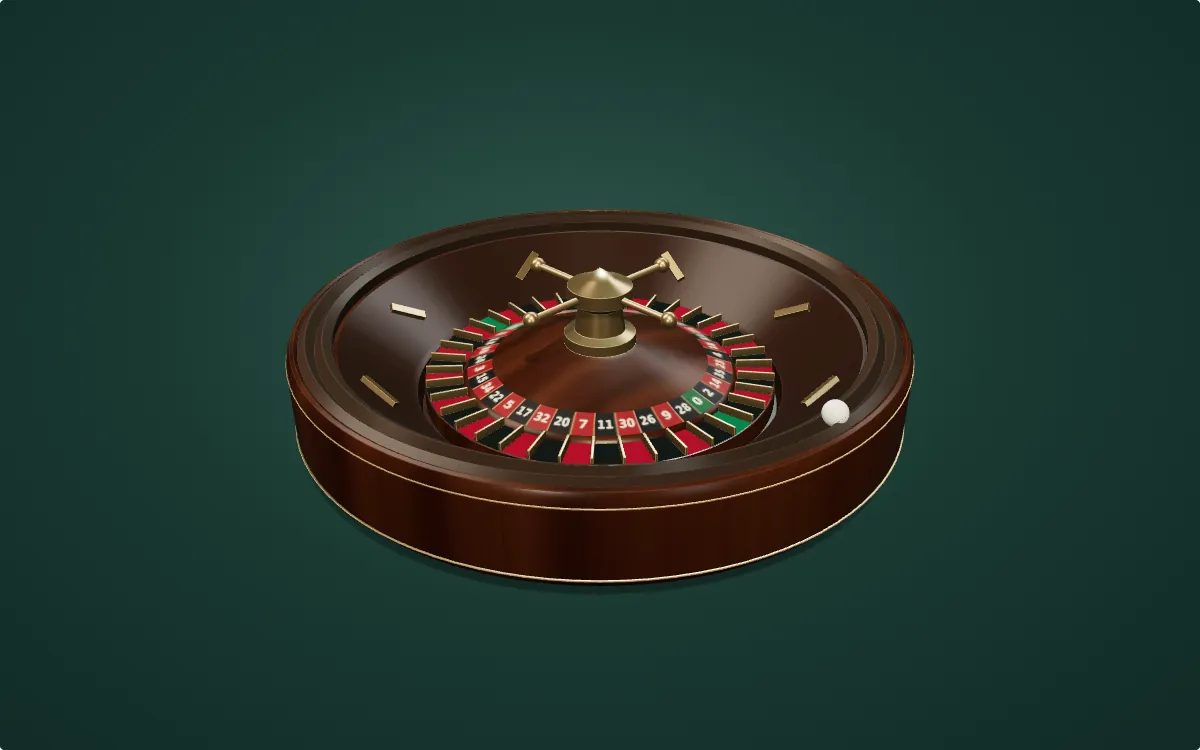
- The bowl. Everything starts with the bowl, the heavy outer body of the wheel that never turns. It carries the ball track along its upper edge and holds the spinning Rotor in its center. Because the bowl stays put, every round happens inside the same fixed frame: the dealer turns the rotor and releases the ball, while the bowl simply keeps the whole mechanism steady.
- The ball track. Around the top of the bowl runs a smooth groove called the ball track. The dealer sends the ball along it, traveling against the direction in which the Rotor turns. For a while the ball circles fast and high; once it slows, it can no longer hold the outer edge and slides down towards the Deflectors and the rotor.
- The deflectors. On the sloping band between the ball track and the Rotor sit small metal pieces known as Deflectors. They are fixed to the bowl, so they never turn. When the falling ball strikes one, it is knocked off its line and its path becomes much harder to predict. A single knock late in the descent can send it to a very different part of the wheel.
- The rotor. The Rotor is the turning center of the wheel, and it carries every numbered pocket. Before each round the dealer sets it spinning in one direction, then sends the ball around the track in the other. The two movements run against each other until the ball loses speed, leaves the track and drops down onto the rotor.
- 38 pockets. Brass dividers split the edge of the rotor into 38 pockets. Thirty-six of them hold the numbers 1 to 36, shared evenly between 18 red and 18 black. The other two are green: the single 0 and the Double zero, marked 00. Red and black alternate all the way round, and the two green pockets sit opposite each other. That second zero lifts the House edge to 5.26%.
- The number ring. The Number ring does not count upwards. Reading clockwise from the green 0, it runs 28, 9, 26, 30, 11, 7, 20, 32, 17, 5, 22, 34, 15, 3, 24, 36, 13, 1, then the green 00, then 27, 10, 25, 29, 12, 8, 19, 31, 18, 6, 21, 33, 16, 4, 23, 35, 14 and 2, which leads back to 0.
- The turret. At the very center stands the turret, a cross-shaped brass handle fixed to the Rotor. The dealer takes hold of it to set the rotor turning, then launches the ball along the outer track the other way. Those two actions together produce the familiar picture of ball and wheel racing in opposite directions.
- The ball in motion. With the rotor turning one way and the ball the other, the ball gradually loses speed. It drops from the track, may strike the Deflectors, and bounces across the pockets before settling. Only when it rests in a single pocket is the round decided. On this wheel, each of the 38 pockets is equally likely to catch it.
- Every part, pulled apart. This exploded view lifts the parts apart, from the outside in: the bowl, the ball track, the Deflectors, the Rotor, the 38 pockets, the Number ring, the turret and the ball. The bowl and the slope stay fixed, while the rotor, pockets, ring and turret turn together as one unit and the ball follows its own path.
- Explore for yourself. Drag to turn the wheel and zoom in on the Rotor, the Deflectors and the Number ring. Find the green 00 opposite the 0: that extra pocket is what changes the odds. A single number still pays 35 to 1, but with 38 pockets instead of 37 the House edge rises from 2.70% to 5.26% on almost every bet.
Turn the wheel in the lesson until you can find 0 and 00 from any starting point, then follow one color around the ring. Big wheel makers such as TCS John Huxley and Cammegh build the bowls to tight tolerances, and the roulette wheel numbers guide explains the sequence and why it was laid out that way.
How does a roulette wheel work mechanically? The rotor sits on a spindle inside the fixed bowl, while the ball runs the track the other way. As it loses speed it drops off the track, strikes the deflector diamonds and rattles across the frets between pockets. The roulette numbers page lists all 38 slots.
Choosing a Table: Double Zero, Single Zero or Triple Zero
Double zero, the US default
Every number pays as if the wheel had 36 pockets. On an American wheel there are 38, so the house keeps 2 pockets out of every 38 spins on average. Two divided by 38 is 5.26%, the house edge on almost every bet you can place. Remove the double zero and it becomes one in 37, or 2.70%.
In money, that difference is easy to see. Across $100 wagered, the average cost on an American wheel is $5.26, on a European wheel $2.70. French roulette tables that use La Partage return half of an even-money stake when zero hits, which cuts that bet to $1.35. The payouts on the felt never change; only the number of pockets does.
Atlantic City tables can be cheaper on even money too. New Jersey lets a casino take only half of a red, black, odd, even, low or high chip when either zero lands, as long as the table says so. Look for that notice: it brings those six bets down to 2.63%, while every other American bet stays at 5.26%.
The one American bet that is worse still is the top line on 0, 00, 1, 2 and 3. It pays 6 to 1 for five numbers, which works out to a 7.89% edge, half again the cost of everything else. Skip it. Any other bet on the same table costs the same 5.26% per dollar.
Triple zero, the most expensive wheel
Some casinos on the Las Vegas Strip have added a third green pocket, 000. That makes 39 pockets while the payouts stay the same, so a single number still pays 35 to 1. Over 39 spins you would win once and get 36 units back for 39 wagered. Three lost in 39 is 7.69%.
In dollars, $100 wagered on a triple-zero table costs $7.69 on average, against $5.26 on double zero and $2.70 on single zero. The third zero adds nearly half again to the double-zero cost, and the felt looks almost identical. Check the head of the layout before you buy in; the triple zero roulette page shows it.
Single zero, cheaper when you can find it
If you have a choice between wheels, the maths settles it: a single-zero table costs roughly half as much per spin for the same bets and the same payouts. Single-zero wheels are less common on the Las Vegas Strip, but they do exist. The American vs European roulette comparison sets the two side by side.
Single-zero tables are often found in high-limit areas or carry a higher minimum than the double-zero tables nearby, so the saving per spin can come with a larger stake per spin. Do the arithmetic for your own bets: $10 a spin costs about 53 cents on average on double zero and 27 cents on single zero, whatever you bet on.
How to Play Roulette at a Casino, Step by Step
Here is how to play roulette at a casino from the moment you walk up to the moment you leave. Dealers in Las Vegas, Atlantic City and other US gaming states run the table the same basic way. Regulators such as the Nevada Gaming Control Board and the New Jersey Division of Gaming Enforcement oversee these games.
Step 1: read the placard and pick a seat
Walk past a few tables before you sit. Read each placard for the inside and outside minimums and the maximums, and look at the head of the layout to see whether it shows one, two or three zeros. A table with a free seat and a pace you can follow beats a cheaper one that is packed three deep.
Step 2: buy in between spins
Wait for the dealer to finish paying, then set your cash on the felt; dealers do not take money from your hand. The dealer counts it and exchanges it for color chips in a shade nobody else is using. Tell the dealer what each chip is worth if you want something other than the default value.
Step 3: place your bets
That is how to bet on roulette in person: chips down while betting is open, squarely on a number for a straight-up bet or on the right line or box for anything else. If a spot is out of reach, put the chips in front of the dealer and name the bet, say five on the second dozen.
Payout drill
The ball drops into 17. On the cloth: 3 chips on corner 16-17-19-20, 2 chips on street 13-14-15 and 5 chips on second dozen. How many chips does the dealer pay out, not counting the stakes that stay in place?
corner 16-17-19-20: 3 × 8 = 24. street 13-14-15 loses 2. second dozen: 5 × 2 = 10. The dealer takes 2 losing chips first. Payout: 34 chips.
Step 4: the call, the drop and the dolly
Betting stays open until the dealer waves a hand across the layout and calls no more bets, usually as the ball begins to slow. After that, nothing on the felt may be touched. When the ball settles, the dealer places the dolly on the winning number, sweeps the losing chips and pays each winner in turn.
Payout drill
The ball drops into 00. On the cloth: 1 chip on top line (0-00-1-2-3), 4 chips on third column and 2 chips on straight up on 00. How many chips does the dealer pay out, not counting the stakes that stay in place?
top line (0-00-1-2-3): 1 × 6 = 6. third column loses 4. straight up on 00: 2 × 35 = 70. The dealer takes 4 losing chips first. Payout: 76 chips.
Step 5: collect, repeat and color up
When you win, the dealer pushes the payout next to your bet; pull it back into your stack. Losing chips are already gone. Decide before the next call whether your bets stay, change or come down. When you are done, color up between spins, take your regular casino chips and cash them at the cage on your way out.
Wheel checks and results boards
Casinos inspect their wheels routinely, checking that the bowl is level and the pockets are sound, and some tables track recent results on an electronic display. That board shows what happened, not what will happen. A wheel with seven reds in a row is just as likely to land red on the next spin as on any other.
Roulette Etiquette and Tipping the Dealer
How to play roulette in Vegas or in Atlantic City follows the same etiquette. Keep drinks and phones off the layout, place your own chips where you can reach them and ask the dealer for help where you cannot. Ask questions between spins. The guide to playing roulette in Vegas covers the Strip in more detail.
Hands off during the payout is the rule regulars notice first. While the dolly stands on the winning number the dealer is paying, and a hand across the felt makes it hard to see which chips belong where. Wait until your payout is pushed to you and the dolly is lifted, then gather your chips and bet again.
Tipping is optional and common. The usual way at a roulette table is to place a bet for the dealer: set a chip down and say it is for the dealer, often on a single number or an outside box. If it wins, the payout goes to the dealer. You can also hand over a chip when you color up.
Asking for change is normal too. If you bought in with large chips and want to make small bets, ask the dealer between spins to break one down. Dealers handle these requests all day, and asking costs nothing, while a wrong-sized bet on a crowded cloth slows everyone down and can leave your intended chip unplaced at the call.
A few other habits keep a table friendly. Do not lean over other players’ bets, do not offer advice nobody asked for, and do not blame the dealer for a losing spin; the dealer launches the ball but cannot steer it. If the table talk sounds like a code, the roulette terms glossary explains the words you will hear.
Common Beginner Mistakes at the Roulette Table
Chasing losses is the costliest beginner mistake. A bad run tempts you to raise the stake and win it back at once, but the next spin carries the same 5.26% cost as the last, now on a larger amount. The money you are chasing is already spent. Bet the size you planned, or stand up.
Betting systems are the second trap. Doubling after every loss, known as the Martingale, wins small amounts often and then loses a large one when a streak meets the table maximum or your bankroll. No pattern of bets changes the edge on each spin. The roulette strategy guide and these practical roulette tips explain what actually helps.
Misreading the top line catches people who like the zeros. A chip on the line where 0, 00, 1, 2 and 3 meet covers five numbers and pays 6 to 1, which looks generous until you compare: every other bet costs 5.26%, this one 7.89%. If you want the zeros, bet them straight up or as a split.
Forgetting that the stake stays on the cloth costs money in a quieter way. When a bet wins, the dealer pays the profit beside it and leaves the original chip in place. If you do not pick it up or move it, it is a live bet on the next spin. Plenty of beginners lose a winning chip this way.
The last common slip is mixing up wheel order and cloth order. On the felt, 17 sits next to 16, 18, 14 and 20. On the American wheel its neighbors are 32 and 5. Numbers that look close on the layout are scattered on the wheel, which is fine, as long as you know it.
Roulette at a Casino vs Online and Live-Dealer Roulette
Roulette also exists on screens, and the game changes less than the setting. Video roulette and many online tables use a random number generator, software that picks the pocket for each spin. Live-dealer roulette streams a real wheel and a real dealer from a studio, and you place bets on a digital layout while the ball spins on camera.
The payouts are the same in all three. A single number still pays 35 to 1 and red still pays 1 to 1, so the odds section above applies unchanged. What you must check is the wheel type: a screen can show a single-zero or a double-zero game, and the average cost per $100 wagered differs by $2.56 between them.
Some screen variants change the payouts themselves. Games such as Lightning Roulette add random multipliers to some numbers and lower the base straight-up payout to fund them, so the usual chart does not apply. Read the paytable before you bet anything. Any game that changes the payouts also changes the house edge, and rarely in your favor.
Pace is the biggest practical difference. A busy casino table runs fewer spins an hour, because the dealer pays everyone by hand. A screen game settles instantly and can run around the clock, so the same stake meets the edge far more often each hour. Online casino games are licensed only in some states.
A real table teaches things a screen cannot: the call of no more bets, the dolly, color chips and the etiquette around them. If you want to learn how to play roulette before a casino trip, use software for the payouts, then expect the real table to move slower, sound louder and give you more time to think between spins.
How to Play Roulette for Beginners: Practice, Budget and a First Session
How to play roulette for beginners comes down to three decisions made before you sit down: how much you will bring, which bets you will use and when you will stop. Write the amount down if it helps. Whatever is left at the end is the result; there is no plan that turns that edge around.
Practice before you go
Practice is the cheapest way to learn how to play roulette. The table near the top of this page runs on the same payout rules as a real double-zero table, so you can place chips, spin and see each return. Do the lessons in order, then repeat the payout drill until you can total a round before you check it.
Next, take the 3D wheel lesson in the wheel section and learn where 0 and 00 sit, then return to the table quiz until you can name every bet on sight. Twenty minutes across those three tools covers most of what a dealer expects a new player to know. The free roulette practice table adds more modes and longer sessions.
Set a session budget
Set your budget as two numbers: the total you are prepared to lose, and the size of each bet. Then do the arithmetic. At $10 a spin for 100 spins you wager $1,000, and the average cost on a double-zero wheel is $52.60. Real sessions swing far above and below that figure, which is why the total cap matters more.
Keep the budget separate from the rest of your wallet, and stop when it is gone or when a time limit you set runs out. Winning sessions need a stopping point as well. If gambling stops feeling like entertainment, the 1-800-GAMBLER helpline is free and confidential, and talking to someone early is easier than talking later.
Your first session
Spend your first half hour on outside bets; their rules are simplest. Red, odd or a single dozen win often enough that you stay at the table and learn the rhythm of betting, the call and the payout. One chip per spin is plenty. Watch how the dealer runs the table more than how the numbers fall.
Once the rhythm feels easy, add one inside bet. A split or a corner near your favorite number makes a good first step, because the payout is easy to check against the chart. If a round confuses you, practice the same position on the practice table near the top of this page before trying it again with real chips.
Pace matters more than people expect. A full table may play fewer rounds an hour than a quiet one, and a quiet table early in the day burns through a bankroll much faster per hour at the same stake. If you want your money to last, a busier table and smaller bets do more than any system ever will.
Small Table Details That Decide How a Session Feels
A few practical details make a first visit smoother for beginners. Sit near the wheel end of the layout if you like to watch the ball, or toward the far end if you mostly bet the columns, whose 2 to 1 boxes sit there. Keep your color chips stacked in front of you.
If your bet wins, say so only if the dealer seems to miss it. Winners are paid in a set order, outside bets first, and dealers rarely skip anyone. A quick word before the dolly is lifted is enough. Once the dolly comes off the layout, betting reopens and a disputed payout becomes much harder to sort out.
The last habit is the one regulars notice: before every spin, glance at your own chips on the cloth and count what is still riding. Winning chips stay where they won, a bet placed for the dealer sits among yours, and a nudged stack can drift onto a line. So, which of those chips did you mean to leave there?