
Roulette tips that start with the wheel you pick
1. Choose single zero over double zero
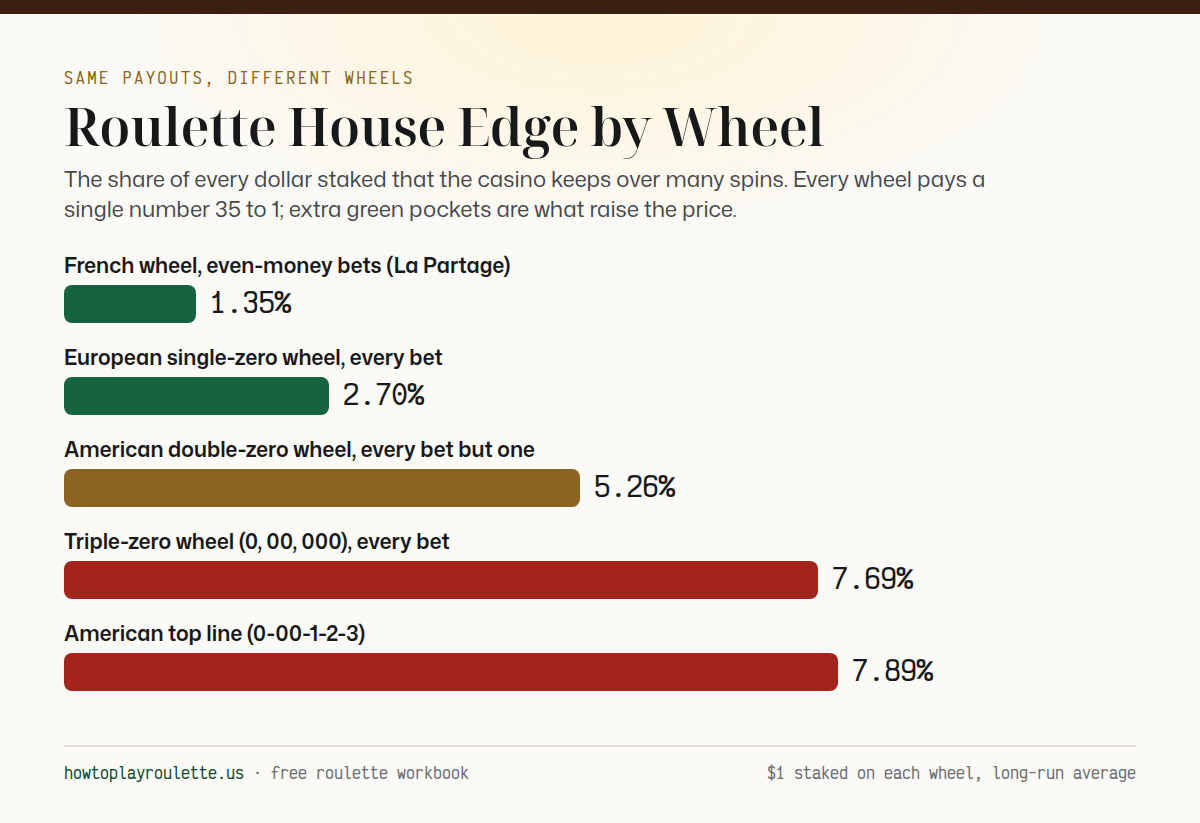
An American wheel has 38 pockets including 0 and 00, and every bet costs 5.26 percent of what you wager. A European wheel has 37 pockets and one zero, so the cost drops to 2.70 percent. Per $100 wagered that is $5.26 against $2.70. The full comparison sits on the American vs European roulette page.
Telling the two apart takes a glance. At the top of the layout, a double-zero table shows two green boxes, 0 and 00, while a single-zero table shows one. The wheel carries the same difference. In Las Vegas or Atlantic City you mostly see double zero, so the casino roulette tips here assume it unless a sign says otherwise.
2. Look for La Partage on even-money bets
French tables often add La Partage or En Prison. When the ball lands on zero, half of your even-money stake comes back. That halves the edge on red, black, odd, even, high and low to 1.35 percent. It is the cheapest bet in roulette, and the French roulette page shows how the rule settles.
Atlantic City has a home-grown version. New Jersey rules let a casino take only half of a losing red, black, odd, even, high or low chip when 0 or 00 lands, and the table must show which rule it uses. At those tables the edge on even-money bets falls to 2.63 percent, so read the sign before you sit.
3. Skip the five-number top line
On the American layout, the top line covers 0, 00, 1, 2 and 3 and pays 6 to 1. It is the only bet on that table with a 7.89 percent edge instead of 5.26. Per $100 wagered you lose $7.89 on average. It is easy to spot: the corner where the zeros meet the first row.
The top line against its neighbors
A chip on the outer corner of 0 and 1. The only five-number bet, and the one to skip.
- Covers
- 5 of 38
- Pays
- 6 to 1
- Wins per 100 spins
- 13.2
- House edge
- 7.89%
Money roulette tips: chip size and session length
4. Size the chip to the session, not the mood
Decide your spending limit, then divide it by the chip value. If $200 buys twenty $10 bets, a bad run can end your evening in fifteen minutes. The same $200 in $5 chips gives forty bets and twice the time at the table. Smaller chips do not change the edge. They change how long you get to enjoy the game.
Here is the arithmetic for that $200. Forty $5 bets on red put $200 through the wheel, and the expected cost is about $10.53, worked out as $200 times 5.26%. Spread over 120 spins, re-betting the same $5 chip as wins come back, the expected cost is about $31.58. The budget lasts because the edge takes small bites.
5. Count spins, because speed is a cost
A quiet table with one player spins much faster than a crowded one. Each spin costs its edge on whatever you have on the felt. Ten dollars on red at an American wheel loses 53 cents per spin on average. Multiply by the number of spins and you have the real price of an hour. Fewer spins, lower bill.
What 1,000 spins cost
Pick a bet. One chip goes on it every spin, on a fair American wheel with 38 pockets. Watch the running total.
- Spins
- 0
- Wins (expected)
- 0
- Chips up or down
- 0
- Longest losing run
- 0
Short runs swing both ways. Over many spins the line drifts toward the dashed one, the average loss the house edge sets, because every bet is paid as if the green pockets were not there.
6. Set a stop point before you buy in
Write the number down, or tell someone. Once it is gone, stand up. The same applies to a time limit. This is the simplest of the roulette tips and the one people break most, usually by chasing a loss with larger bets. The Martingale page shows in dollars how chasing turns small losses into large ones.
If a limit stops holding, self-exclusion is the stronger tool. New Jersey’s Division of Gaming Enforcement runs a voluntary list that bars a person from Atlantic City casinos, licensed online gaming or both, for one year, five years or life. Many other states with casinos run similar programs, and 1-800-GAMBLER can point you to yours.
The best numbers to bet on roulette, and why there are none
7. Ignore hot numbers and the scoreboard
Most tables show a board of recent results, pure entertainment. On a fair wheel every spin is independent, and each pocket keeps its 1 in 38 chance. A hot number is not due to rest, and a cold one is not due to arrive. If a wheel ever were biased, casinos inspect for exactly that; see whether roulette is rigged.
People still ask for the 10 best numbers on roulette, built from birthdays or past results. Cover ten numbers straight up and you win on 10 of 38 pockets, about 26.3 percent of spins. Every chip still loses 5.26 percent on average. Choosing which ten makes no difference. Here is a drill that shows a mixed spread settling:
Payout drill
The ball drops into 8. On the cloth: 1 chip on straight up on 17, 1 chip on straight up on 23 and 2 chips on split 8-11. How many chips does the dealer pay out, not counting the stakes that stay in place?
straight up on 17 loses 1. straight up on 23 loses 1. split 8-11: 2 × 17 = 34. The dealer takes 2 losing chips first. Payout: 34 chips.
Work it out before you open the answer. The two chips on the 8-11 split win at 17 to 1, so they return their stake plus 34. The chips on 17 and 23 are swept. If the payout ratios still feel shaky, keep the roulette payouts chart open in another tab while you practice.
Roulette tips and tricks that are really just maths
8. Know that systems only rearrange the losses
Doubling systems, Fibonacci, d’Alembert: each changes your next bet size, never the odds of the spin. The average loss stays at the house edge times the total wagered, and progressions raise that total. Good roulette tips say so. The roulette strategy overview compares the common systems so you can see why none of them beats the wheel.
9. Use outside bets to stretch a small budget
Red or black wins 18 of 38 spins on an American wheel, 47.37 percent of the time. A single number wins about 2.63 percent. Both cost the same 5.26 percent on average, but outside bets swing far less, so a small bankroll survives longer. Want the payoff of a long shot? Accept a shorter session.
Outside bets also mix well. Try the drill below: two chips on the second dozen, 13 to 24, and one chip on red, with the ball landing on 17. Before opening the answer, decide which chips win, what each pays and how many chips come back to you. These tips to play roulette calmly start with doing this sum.
Payout drill
The ball drops into 17. On the cloth: 2 chips on second dozen and 1 chip on red. How many chips does the dealer pay out, not counting the stakes that stay in place?
second dozen: 2 × 2 = 4. red loses 1. The dealer takes 1 losing chip first. Payout: 4 chips.
The dozen chips pay 2 to 1, so two chips win four and come back with their stake, six in all. The red chip loses, because 17 is black. Net, you are three chips ahead on that spin. Swap the hit to 00 in your head and all three chips go, which is the trade every outside spread makes.
Roulette etiquette at a real table
10. Put cash on the felt and wait your turn
At an American table you place cash on the layout and the dealer converts it into color chips. Dealers generally do not take money from your hand; it goes on the felt. Wait until the dealer has cleared losing bets and paid the winners before placing new chips. The marker on the winning number means hands off until payouts finish.
When the dealer waves a hand over the layout and calls no more bets, stop. Late chips may be pushed back, and reaching across the felt while the ball slows is the fastest way to irritate a table. If you cannot reach, hand the chips over and name the bet. The roulette terms glossary explains these calls.
One of the plainest tips for playing roulette: read the placard. It shows the minimum and maximum, and at many US tables the inside minimum can be spread across numbers while each outside bet must meet the minimum on its own. A $10 table may accept ten $1 chips on single numbers but not a $5 chip on red.
11. Keep your color separate and cash out properly
Each player gets a unique color so the dealer can pay the right person. Those wheel chips have no value elsewhere in the casino. When you leave, push them to the dealer, who swaps them for regular chips. If you tip, a small bet for the dealer or a chip on the way out is common.
How to play roulette like a pro without pretending
12. Practice the layout before money is involved
Professional-looking play is mostly fluency: knowing where a corner goes, which splits are legal and what a street pays without asking. Learn that on a free roulette table and the real table feels calm instead of rushed. You also learn your own pace, which helps you judge how many spins your budget covers.
Fluency also means not overthinking. Pick your bets before the spin, place them in one move, then watch the ball. These roulette tips work at any seat. Sit near the wheel end if you like seeing the rotor; sit at the far end if you prefer the layout within easy reach. Some people switch ends on the same night.
Of all these roulette tips, take the first into a casino. One green pocket instead of two halves the price of every chip you place, and no amount of etiquette or chip discipline matches that. On a crowded Saturday the single-zero table may carry a higher minimum, so check the placard before you sit down.