
Is roulette rigged, or is the edge simply built in?
Start with the honest part. The casino’s advantage is printed in the payouts. A straight-up bet pays 35 to 1, but an American wheel has 38 pockets, so a fair payout would be 37 to 1. That gap is the house edge, and nobody hides it. The table below shows it bet by bet.
Chance per spin · house edge
| Bet | American | European | French |
|---|---|---|---|
| Straight up | 2.63% · 5.26% | 2.70% · 2.70% | 2.70% · 2.70% |
| Split | 5.26% · 5.26% | 5.41% · 2.70% | 5.41% · 2.70% |
| Street | 7.89% · 5.26% | 8.11% · 2.70% | 8.11% · 2.70% |
| Corner | 10.53% · 5.26% | 10.81% · 2.70% | 10.81% · 2.70% |
| Top line (0-00-1-2-3) | 13.16% · 7.89% | — | — |
| First four (0-1-2-3) | — | 10.81% · 2.70% | 10.81% · 2.70% |
| Six line | 15.79% · 5.26% | 16.22% · 2.70% | 16.22% · 2.70% |
| Dozen | 31.58% · 5.26% | 32.43% · 2.70% | 32.43% · 2.70% |
| Column | 31.58% · 5.26% | 32.43% · 2.70% | 32.43% · 2.70% |
| Red/black, odd/even, 1-18/19-36 | 47.37% · 5.26% | 48.65% · 2.70% | 48.65% · 1.35% |
Each cell shows the chance that the bet wins on one spin, then the share of every dollar wagered that the house keeps over time. A dash means the bet is not on that cloth.
Read across a row and you see the same story everywhere: 5.26 percent on almost every American bet, 7.89 on the top line, 2.70 on single-zero wheels and 1.35 on French even-money bets with La Partage. That margin is why a licensed casino has no need to fake results. Over thousands of spins, the edge alone pays for the building.
So when someone asks “is roulette rigged?”, the better question is whether a particular wheel is behaving as it should. That is a question about maintenance, surveillance and testing. Each of those has a clear answer in a regulated US casino, and none of them depends on trusting the people who profit from the game.
Can roulette be rigged at all?
Can roulette be rigged? Physically, yes: any machine can be tampered with, and history has its share of crooked wheels in unlicensed back rooms. What changes in a licensed US casino is everything around the wheel: approved equipment, cameras over every table, inspection logs and a regulator that can take away the license.
What Nevada casinos kept from roulette
Share of the drop kept by every roulette table in Nevada, per calendar year, against the house edge of one American bet.
Dashed line: the house edge on one American bet, 5.26%. Lighter bar: 2020, with casinos closed for part of the year.
- Average 2014–2024
- 18.3%
- Kept in 2024
- $440M
- Tables, 2024 average
- 435
Show the figures
Run the numbers from the casino’s side. A table that takes $10,000 in bets keeps about $526 on average from the double-zero edge alone, with no risk beyond the swings. A rigged wheel would add little to that and put the license behind every table at risk. That is why the realistic worry is wear, not fraud.
How casinos inspect and level a roulette wheel
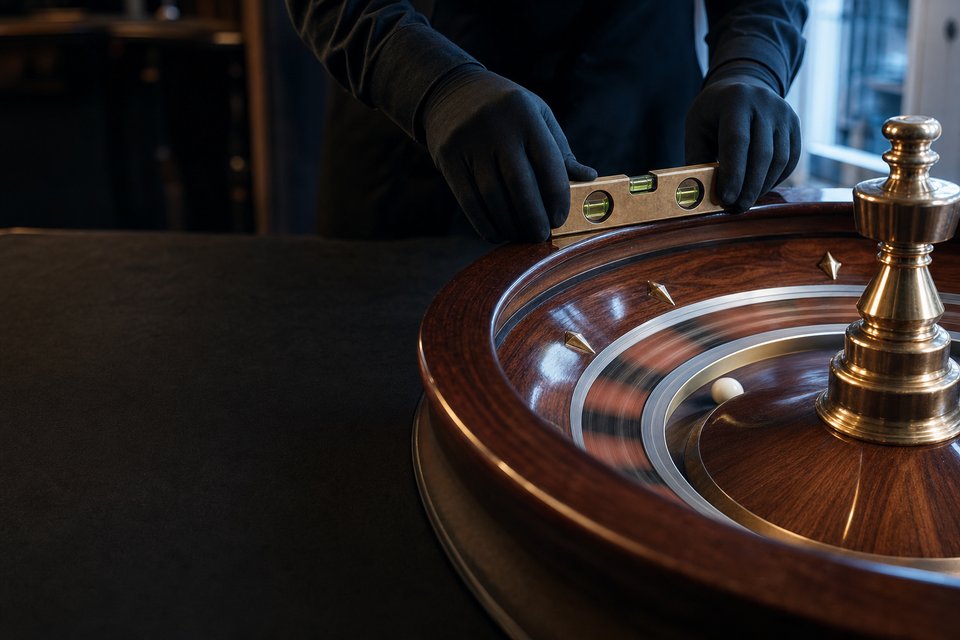
A roulette wheel is a precision instrument. The rotor, the turning center with its pockets, sits on a spindle inside a heavy bowl, and it must turn true. Before play and at regular intervals staff check the wheel with a spirit level, because even a slight tilt can favor one side of the bowl over time.
Inspections also cover the frets, the thin metal separators between pockets. A loose fret can catch the ball more often than its neighbors. Staff check the ball track for wear, the rotor’s free spin and the deflectors, the small diamonds that knock the ball off its path. Makers such as TCS John Huxley and Cammegh design wheels for this servicing.
What you can check yourself at the table
You can watch most of this process yourself. The dealer spins the rotor one way and launches the ball the other way on every spin, and a ball that does not complete enough laps of the track may be called a no spin and launched again. The result is marked with the dolly on the layout in plain view.
Look up, too. The dark glass domes in the ceiling hold cameras that record every spin, and the footage is what a casino reviews when a payout is disputed. If you think a result was wrong, ask the dealer to call a floor supervisor before the next spin. That is the ordinary process, and asking costs nothing.
Results logs and statistical checks
Many tables show the latest winning numbers on an electronic display, and the casino keeps the same record. Over a few hundred spins the counts swing wildly. Only over many thousands would a pocket that comes up far too often stand out, which is why spotting a genuinely faulty wheel takes patience and a very long record.
Run your own results log: 1,000 spins
Pick a bet. One chip goes on it every spin, on a fair American wheel with 38 pockets. Watch the running total.
- Spins
- 0
- Wins (expected)
- 0
- Chips up or down
- 0
- Longest losing run
- 0
Short runs swing both ways. Over many spins the line drifts toward the dashed one, the average loss the house edge sets, because every bet is paid as if the green pockets were not there.
Roulette wheel bias: what it is and why it fades
Wheel bias is an accident, not a trick. It is a physical flaw that makes some pockets slightly more likely than 1 in 38. The classic story is Joseph Jagger, usually said to have tracked a flawed wheel at Monte Carlo in the 1870s. The details vary with the teller, but the principle is sound.
A better-documented case comes from Spain. In the early 1990s Gonzalo García-Pelayo and his family recorded thousands of spins at the Casino Gran Madrid, found wheels that favored certain numbers and won heavily before the casino barred them. In 2004 Spain’s Supreme Court upheld their right to enter the casinos that had banned them.
Why modern wheels are harder to exploit
Wheel makers responded. Low-profile frets and shallower pockets let the ball bounce more randomly, and balanced rotors keep the spin even. Combined with regular leveling and inspection, that leaves very little room for a bias big enough to beat a 5.26 percent edge. Finding one would take far more data than any casual player could collect.
Can a dealer control where the ball lands?
This is one of the most common worries, and it deserves a direct answer. A dealer launches the ball against the spin of the rotor, around a track, onto deflectors and finally into pockets that are themselves moving. Each of those steps adds chaos. No hand can reliably steer the result through all of them.
Some players talk about a dealer signature, a habitual spin speed that supposedly repeats results. Yet the rotor speed changes every spin and the ball still meets the deflectors, so no release maps to one pocket. Any slight pattern would have to beat the house edge, and the roulette wheel page shows how the pocket order scatters neighboring numbers.
Do electronic roulette machines cheat? How labs test them
Electronic roulette comes in two forms. Some machines use a real wheel with an automated ball launch; others are fully digital and use a random number generator, an RNG, to pick the pocket. Either way, in regulated US jurisdictions the game must pass independent testing before it reaches a casino floor.
Gaming Laboratories International, better known as GLI, publishes the technical standards many regulators use. Its standard for electronic table games, GLI-24, requires an RNG to be statistically independent, unpredictable and resistant to outside interference. For roulette, the simulated game must show the same probabilities as the live one. That means one pocket in 38 for a double-zero layout.
The Nevada and New Jersey approval process
In Nevada, gaming devices are tested by independent laboratories registered with the Nevada Gaming Control Board, reviewed by the Board’s Technology Division and approved by the Nevada Gaming Commission. In New Jersey, engineers at the Division of Gaming Enforcement’s Technical Services Bureau test electronic games before they can be used in Atlantic City casinos.
Is roulette rigged online where it is legal?
Regulated online casino games exist only in a handful of US states, and they face the same kind of scrutiny. New Jersey’s Technical Services Bureau also evaluates internet gaming systems. The wheel you see on screen is either a live dealer stream from a studio or an RNG game that went through approval. Offshore sites operate outside that system entirely.
That difference is practical, not abstract. With an unlicensed site, there is no lab report, no regulator and nobody to complain to. If you are unsure whether a game is legal where you live, check your state regulator first. Systems that promise to beat any wheel are another matter, and the martingale breakdown shows why.
How rare is a run of ten reds? On an American wheel it is (18/38) to the tenth power, about 0.057%, or roughly 1 in 1,758 tries. That sounds tiny until you count the tables. Spread across every wheel and every night in a state, runs like that turn up somewhere more often than the people watching expect.
Most people who ask is roulette rigged are reacting to streaks, and streaks are normal. Ten reds in a row feel suspicious, yet they happen by chance. If you want sensible table habits instead of suspicion, read the roulette tips page, compare systems on roulette strategy, or look up unfamiliar words in the roulette terms glossary.
One practical check stays in your hands at any table: look at the wheel itself. Count the green pockets before you buy in. Two green pockets cost you 5.26 percent per bet, one costs 2.70, as the American vs European roulette comparison shows. That difference, unlike any rumor about magnets, shows up on every single spin you play.