
American Roulette and European Roulette: One Pocket Apart
Side by side, the two wheels look nearly identical. Both have red and black numbers from 1 to 36 and both have a green 0. The American roulette wheel adds a second green pocket, 00, set directly opposite the 0. That makes 38 pockets against 37, and it is the only physical difference that matters to your money.
The payouts do not change to make up for it. A straight-up number pays 35 to 1 on either wheel, so a winning $10 chip returns $360. On 37 pockets you hit that number 1 time in 37, or 2.70%. On the double zero roulette wheel you hit it 1 time in 38, or 2.63%. Small gap, big price.
That one pocket touches every bet on the board. A red bet on American roulette covers 18 of 38 pockets, while the same chip on a European wheel covers 18 of 37. A dozen covers 12 of 38 against 12 of 37. Both games pay the same price for each win, so the American version hands you fewer winning pockets.
The European Roulette Wheel, Pocket by Pocket
The European roulette wheel also orders its numbers differently. Clockwise from the 0 it runs 32, 15, 19, 4, 21, 2, 25, 17, 34, 6, 27, 13, 36, 11, 30, 8, 23, 10, 5, 24, 16, 33, 1, 20, 14, 31, 9, 22, 18, 29, 7, 28, 12, 35, 3 and 26. Red and black still alternate.
The European roulette red numbers list
The red numbers are the same on both wheels: 1, 3, 5, 7, 9, 12, 14, 16, 18, 19, 21, 23, 25, 27, 30, 32, 34 and 36. The other 18 numbers from 1 to 36 are black, and the 0 is green. A red numbers list for European roulette works on an American table too.
The guided lesson below builds the single-zero wheel in 3D. Spin it and follow the ball from the track to the pocket, then look for the single green pocket between 26 and 32. If you want to compare it with the double-zero version, the roulette wheel page runs the same kind of lesson on the American wheel.
Guided lesson: the single-zero roulette wheel, part by part
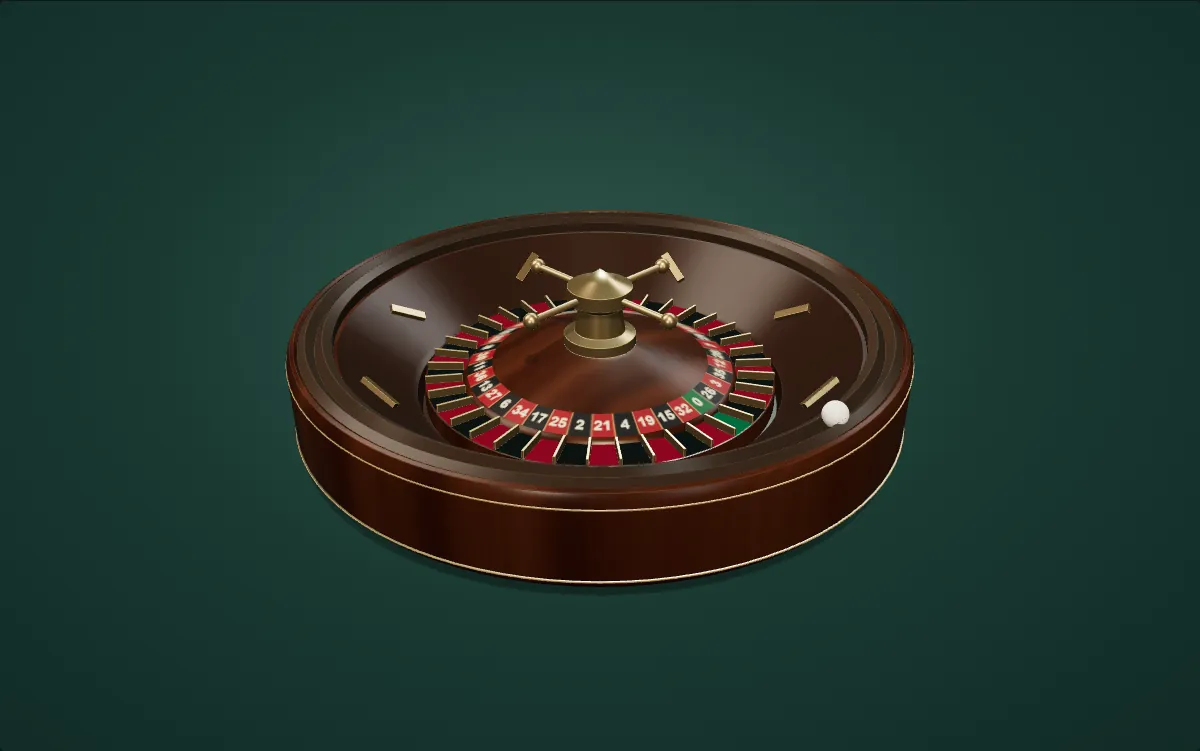
- The bowl. The bowl is the solid outer housing of the wheel, and it stays motionless for the whole round. Its upper edge holds the ball track, and its center cradles the Rotor. Think of it as the stage on which everything else moves: the dealer spins the rotor and sends the ball on its way, but the bowl itself never shifts.
- The ball track. Cut into the top of the bowl is a narrow circular channel: the ball track. The ball is launched along it in the opposite direction to the Rotor. It laps the wheel several times, high up and quickly, and each lap costs it a little speed until it can no longer stay on the rim and falls towards the Deflectors.
- The deflectors. Between the track and the Rotor, the bowl slopes inwards, and fixed metal studs called Deflectors are set into that slope. They do not rotate. A ball dropping from the rim often clips one of them and changes direction without warning, which is a large part of why its landing spot is so hard to call in advance.
- The rotor. The Rotor is the spinning inner section, and every numbered pocket sits on it. The dealer gives it a turn before each round, then launches the ball in the opposite direction. Ball and rotor keep moving against each other until the ball has lost enough speed to leave the track and fall inwards.
- 37 pockets. Thin brass walls divide the rim of the rotor into 37 pockets. The numbers 1 to 36 fill 36 of them, half colored red and half black. The last pocket is the green Single zero. Going round the wheel, red and black take turns pocket by pocket, and only the green zero breaks that pattern.
- The number ring. Around the rotor, the Number ring follows a fixed sequence rather than counting order. Clockwise from 0 it reads 32, 15, 19, 4, 21, 2, 25, 17, 34, 6, 27, 13, 36, 11, 30, 8, 23, 10, 5, 24, 16, 33, 1, 20, 14, 31, 9, 22, 18, 29, 7, 28, 12, 35, 3 and 26, and then returns to the zero.
- The turret. The cross-shaped turret rising from the middle of the Rotor is the dealer's grip. One hand uses it to spin the rotor; the other sends the ball around the track in the reverse direction. That pairing is what gives every round its typical look, with ball and rotor traveling against each other.
- The ball in motion. Ball and rotor run in opposite directions until the ball slows too much to stay on the track. It slides down past the Deflectors, hops between several pockets and finally stops. The winning number exists only from that moment on, and each of the 37 pockets has the same chance of holding the ball.
- All eight parts. Pulled apart and listed from the outside in, the wheel consists of the bowl, the ball track, the Deflectors, the Rotor, the 37 pockets, the Number ring, the turret and the ball. In use, the rotor assembly spins inside the stationary bowl while the ball takes its own route around and then down.
- Explore for yourself. Turn the wheel with your mouse or finger and zoom in on the Rotor, the Deflectors and the Number ring. With only one green pocket, a single number pays 35 to 1 out of 37 possible results, which puts the House edge at 2.70%. A double-zero wheel pays the same but has 38 pockets, so its edge is 5.26%.
The mechanics are the same on both wheels: a fixed bowl, a spinning rotor, metal deflectors and a ball launched against the rotor’s direction. Wheel makers such as TCS John Huxley and Cammegh build both versions. Only the pocket count and sequence change, so do not expect a betting system built for one wheel’s layout to carry over.
Same Payouts, Different Odds: The American Roulette House Edge
Here is the arithmetic behind the price. Bet one unit on every number on a European wheel and you stake 37 units. The winner returns 36, so the house keeps 1 of 37, which is 2.70%. Do the same on the American wheel and you stake 38 units to get 36 back. The house keeps 2 of 38, or 5.26%.
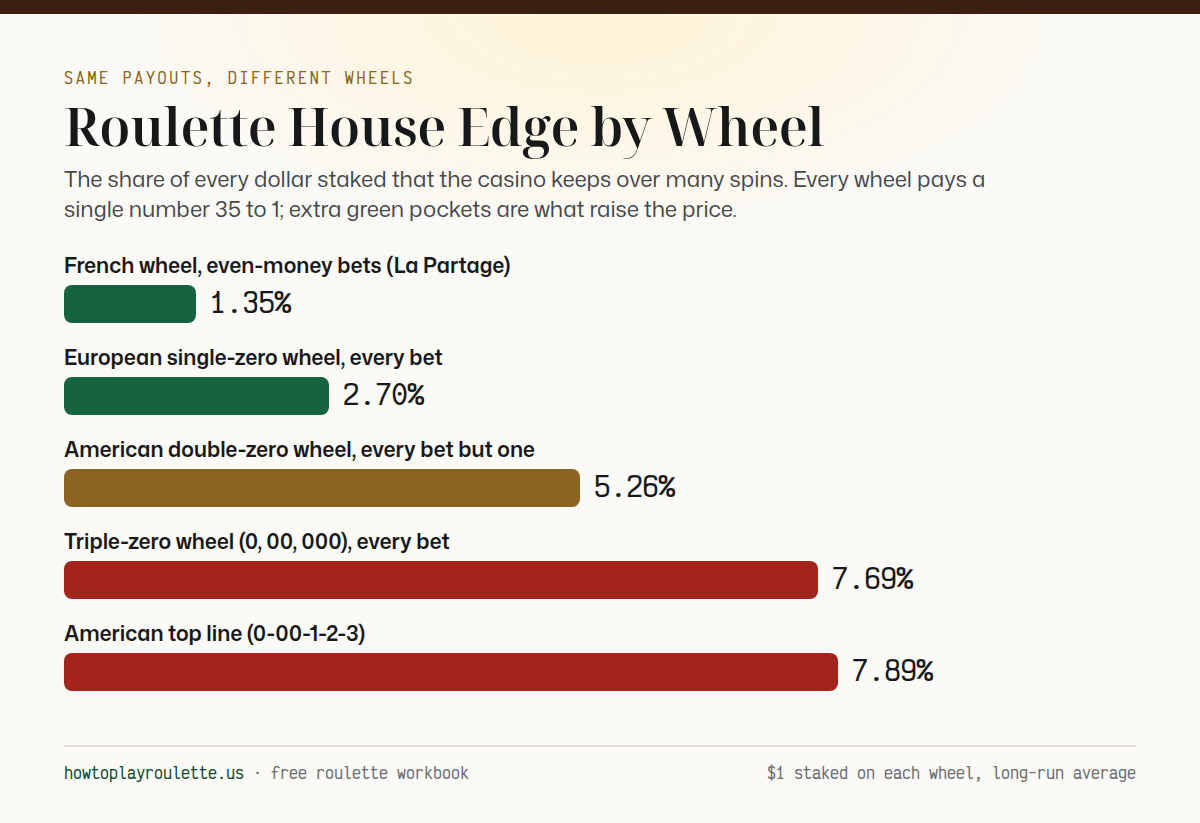
The table below runs that sum for every bet family on American, European and French tables. Read down the house edge column. On the American roulette table every bet sits at 5.26% apart from the top line. On the European wheel every bet sits at 2.70%. Only French even-money bets drop lower, to 1.35%.
Chance per spin · house edge
| Bet | American | European | French |
|---|---|---|---|
| Straight up | 2.63% · 5.26% | 2.70% · 2.70% | 2.70% · 2.70% |
| Split | 5.26% · 5.26% | 5.41% · 2.70% | 5.41% · 2.70% |
| Street | 7.89% · 5.26% | 8.11% · 2.70% | 8.11% · 2.70% |
| Corner | 10.53% · 5.26% | 10.81% · 2.70% | 10.81% · 2.70% |
| Top line (0-00-1-2-3) | 13.16% · 7.89% | — | — |
| First four (0-1-2-3) | — | 10.81% · 2.70% | 10.81% · 2.70% |
| Six line | 15.79% · 5.26% | 16.22% · 2.70% | 16.22% · 2.70% |
| Dozen | 31.58% · 5.26% | 32.43% · 2.70% | 32.43% · 2.70% |
| Column | 31.58% · 5.26% | 32.43% · 2.70% | 32.43% · 2.70% |
| Red/black, odd/even, 1-18/19-36 | 47.37% · 5.26% | 48.65% · 2.70% | 48.65% · 1.35% |
Each cell shows the chance that the bet wins on one spin, then the share of every dollar wagered that the house keeps over time. A dash means the bet is not on that cloth.
Roulette house edge, European vs American: the six line test
A $10 six line pays 5 to 1 on both wheels, so it wins $50 when one of its six numbers hits. It wins 16.22% of the time on a European wheel and 15.79% on an American one. Over $100 wagered on six lines, that is an average cost of $2.70 against $5.26, the same gap as every other bet.
What the gap costs per session
Picture 60 bets of $10, a total of $600 wagered. On an American wheel the average loss is 600 times 5.26%, about $31.56. On a European wheel it is 600 times 2.70%, about $16.20. French even-money bets under La Partage bring it to about $8.10. Results swing widely in the short run, but those averages never move.
Spin both wheels 1,000 times
Pick a bet and a wheel. One chip goes on it every spin, on a fair wheel. Watch the running total.
- Spins
- 0
- Wins (expected)
- 0
- Chips up or down
- 0
- Longest losing run
- 0
Short runs swing both ways. Over many spins the line drifts toward the dashed one, the average loss the house edge sets, because every bet is paid as if the green pockets were not there.
Even-money bets on each wheel
Red, black, odd, even, 1 to 18 and 19 to 36 each cover 18 numbers. On a European wheel they win 48.65% of the time, and on the American wheel 47.37%. That gap of just over one percentage point is the difference between losing $2.70 and $5.26 per $100. The roulette payouts chart lists the chance for every other bet.
How to Play European Roulette: Rules on the Single-Zero Table
You play European roulette exactly like the American game. Buy chips, place them on the cloth while the ball circles, and wait for the dealer to mark the winning number. The board simply has one green box at its head instead of two. Try the quiz below to find your way around the single-zero layout before you sit down.
The single-zero wheel and table
One bet changes with the board. On the American table the five-number top line covers 0, 00, 1, 2 and 3 for 6 to 1 at a 7.89% edge, the worst bet in the house. The European table replaces it with the first four, covering 0, 1, 2 and 3. It pays 8 to 1 and costs the standard 2.70%.
Everything else on the European roulette table reads the same way: three columns of twelve, three dozens, six even-money boxes and the same inside bets from straight up to six line, at the same prices. If you already know the American board from how to play roulette, you will need about one spin to adjust.
Practice helps before a trip. A European roulette simulator lets you place the same chips on a single-zero board and watch how often the 0 eats your outside bets, once every 37 spins on average. The free roulette page covers practice options for both wheels. The roulette table layout guide maps the board box by box, single-zero head included.
Why American Roulette Kept the Double Zero
Early French wheels carried both a 0 and a 00. In 1843 François and Louis Blanc opened a casino at Bad Homburg in Germany with a single-zero wheel, which cut the house edge nearly in half for players. The single-zero wheel later became the game at Monte Carlo and spread across Europe from there.
In the United States the older double-zero design stayed put, and the American roulette wheel is still the default from the Las Vegas Strip to Atlantic City. The story that Blaise Pascal invented the wheel is legend. For the house it is a simple business choice, since a double-zero table earns nearly twice as much per dollar played.
French Roulette: The European Wheel with Kinder Rules
French roulette uses the European wheel, so the 37 pockets and the 2.70% edge carry over. What it adds are rules for the even-money bets. Under La Partage, when 0 comes up you get half of your red, black, odd, even, high or low stake back. En Prison holds the stake for the next spin instead.
Either rule halves the even-money cost to 1.35%, the cheapest standard bet in roulette. Other bets stay at 2.70%. The French roulette page explains the table, its French bet names and the call bets around the wheel. If you are weighing systems on any of these wheels, the roulette strategy guide shows what they can and cannot change.
A double-zero table can borrow part of that idea. In Atlantic City, state rules permit a casino to give back half of an outside even-money stake when 0 or 00 lands, provided the table notice says so. That brings those six bets to 2.63%, close to the European price, though straight-up numbers, splits, dozens and columns still cost 5.26%.
Finding a Single-Zero Table in the United States
Most US tables are double zero, and some Las Vegas casinos have gone further with a triple zero roulette wheel that adds a 000 and pushes the edge to 7.69%. Single-zero tables do exist in some higher-end Las Vegas rooms, though usually at higher minimum bets than the American tables nearby. Availability changes, so it pays to ask.
If American roulette is the only game on offer, your choice of bet barely matters. Every wager except the top line carries the same 5.26% edge, so a chip on red and a chip on 17 cost the same on average. Skip the top line and treat the edge as the price of an evening’s entertainment.
Say a single-zero table has a $25 minimum: 2.70% of $25 is about 68 cents per spin on average, while 5.26% of a $15 bet on a double-zero table is about 79 cents. The bigger minimum can be the cheaper seat. Count the green pockets first, then look at the placard.