

How a Roulette Wheel Works: Bowl, Rotor and Ball
A casino roulette wheel has two main parts. The outer bowl, sometimes called the stator, never moves. It holds the ball track around its upper rim and a sloping wall below it. Inside the bowl sits the rotor, a heavy disc that turns on a precision spindle and carries the numbered pockets around its outer edge.
Read the video script
The ball track and the bowl
The dealer flicks the ball along the track in the opposite direction to the rotor. For several laps it hugs the rim. As friction slows it, the ball loses its grip and drops down the sloping wall toward the rotor. From then on it rattles, a sign the spin is nearly over.
Direction matters too. The rotor and the ball always travel in opposite directions, and in many casinos the dealer switches direction from one spin to the next. The opposing motion keeps the ball moving fast relative to the pockets right up to the drop, which is one more reason a dealer cannot steer the result with any real precision.
The rotor and its pockets
On an American roulette wheel the rotor carries 38 pockets of equal size, split by thin metal dividers called frets. The chrome handle in the middle, the turret, lets the dealer spin the rotor smoothly. A fair spin needs every pocket to share one width and depth, so no number catches the ball more readily.
Deflectors: the diamonds that scramble the ball
Fixed to the sloping wall are metal deflectors, often called diamonds or canoes. Wheels carry several, spaced evenly, some upright and some flat. A ball that hits one jumps sideways or upward, and its next bounce becomes almost impossible to predict. Without them the ball would slide straight into the pockets in a far more readable way.
The American Roulette Wheel: 38 Pockets and Two Green Zeros
The American roulette wheel is the double zero wheel, and it is the standard version you will meet on the Las Vegas Strip and in Atlantic City. It holds 36 numbered pockets colored red or black plus two green ones, 0 and 00. So the answer to how many numbers on a roulette wheel of this type is 38.
Those two green pockets are the house’s advantage. A straight bet on one number pays 35 to 1, a fair price on a 36-pocket wheel. On 38 pockets the chance of hitting your number is 1 in 38, or 2.63%. The casino keeps 2 of every 38 units bet on average, which works out to 5.26%.
Short version: more pockets, same payouts. Every standard bet on this American wheel carries that 5.26% edge, one number or a whole color. The only exception is the five-number top line on 0, 00, 1, 2 and 3, which pays 6 to 1 and costs 7.89%. The roulette payouts page lists every bet with its price.
At a US table the wheel sits at one end of the felt. The highest number on the roulette wheel is 36, and the green 0 and 00 count as numbers you can bet, not blanks. A small sign posts the table minimum. After each spin the dealer sets a marker called the dolly on the winning number.
Roulette Wheel Odds and Payouts, With a Chip Example
Roulette wheel odds come straight from the pocket count. On a double zero wheel, a bet covering six numbers wins about six times in every 38 spins, and the payout is set as if the wheel had only 36 pockets. The table shows the main bets, what each pays and the chance per spin on both wheels.
| Bet | Pays | Pockets covered | Chance, double zero (38) | Chance, single zero (37) |
|---|---|---|---|---|
| Straight up | 35 to 1 | 1 | 2.63% | 2.70% |
| Split | 17 to 1 | 2 | 5.26% | 5.41% |
| Street | 11 to 1 | 3 | 7.89% | 8.11% |
| Corner | 8 to 1 | 4 | 10.53% | 10.81% |
| Six line | 5 to 1 | 6 | 15.79% | 16.22% |
| Dozen or column | 2 to 1 | 12 | 31.58% | 32.43% |
| Red/black, odd/even, 1-18/19-36 | 1 to 1 | 18 | 47.37% | 48.65% |
You put $5 on 0 and $5 on red. The ball lands in 0. Your green chip pays 35 to 1, so the dealer pushes $175 across and leaves your $5 in place, while the red chip is swept away. You are up $170 on the spin. Had the ball found 00 instead, both chips would have lost.
Payout drill
The ball drops into 0. On the cloth: 1 chip on straight up on 0 and 1 chip on red. How many chips does the dealer pay out, not counting the stakes that stay in place?
straight up on 0: 1 × 35 = 35. red loses 1. The dealer takes 1 losing chip first. Payout: 35 chips.
No arrangement of chips changes the price. Every line in the table costs the same 5.26% on a double zero wheel, because each payout falls short of fair odds by the same two pockets. That is why any roulette wheel strategy built on hot or sleeping numbers is selling a story. The roulette strategy page tests the popular systems.
Roulette Wheel Numbers in Order, and Why They Look Random
The roulette wheel numbers do not run 1, 2, 3 around the rim. Clockwise from 0, the American order reads 0, 28, 9, 26, 30, 11, 7, 20, 32, 17, 5, 22, 34, 15, 3, 24, 36, 13, 1, then 00, 27, 10, 25, 29, 12, 8, 19, 31, 18, 6, 21, 33, 16, 4, 23, 35, 14, 2.
Random in practice: 1,000 spins
Pick a bet. One chip goes on it every spin, on a fair American wheel with 38 pockets. Watch the running total.
- Spins
- 0
- Wins (expected)
- 0
- Chips up or down
- 0
- Longest losing run
- 0
Short runs swing both ways. Over many spins the line drifts toward the dashed one, the average loss the house edge sets, because every bet is paid as if the green pockets were not there.
The ring below draws that order. Look for three patterns. Red and black alternate all the way round, with green only at 0 and 00. The two zeros face each other across the rotor. And each number sits directly opposite its consecutive partner: 1 faces 2, 17 faces 18, 35 faces 36, and so on.
That arrangement is deliberate. Mixing red and black, odd and even, low and high means no arc of the wheel leans toward one outside bet. If the roulette wheel numbers ran in sequence, a cluster of low numbers on one side could matter on a wheel with a slight tilt. Scattering them flattens that.
An aside: add the numbers 1 to 36 and you get 666, since 36 times 37 divided by 2 is 666. That sum, together with the legend that credits Blaise Pascal with an early version of the wheel, feeds plenty of dark folklore, none of which changes a spin. The roulette history page separates legend from record.
Watch the Double Zero Roulette Wheel Spin, Step by Step
Reading only gets you so far. The guided lesson below builds an American roulette wheel in 3D and walks through a full spin: the rotor turning, the ball launched against it, the drop off the track, the hit on a deflector and the final settle. Rotate it, pause it and follow the labels.
Guided lesson: the American roulette wheel, part by part
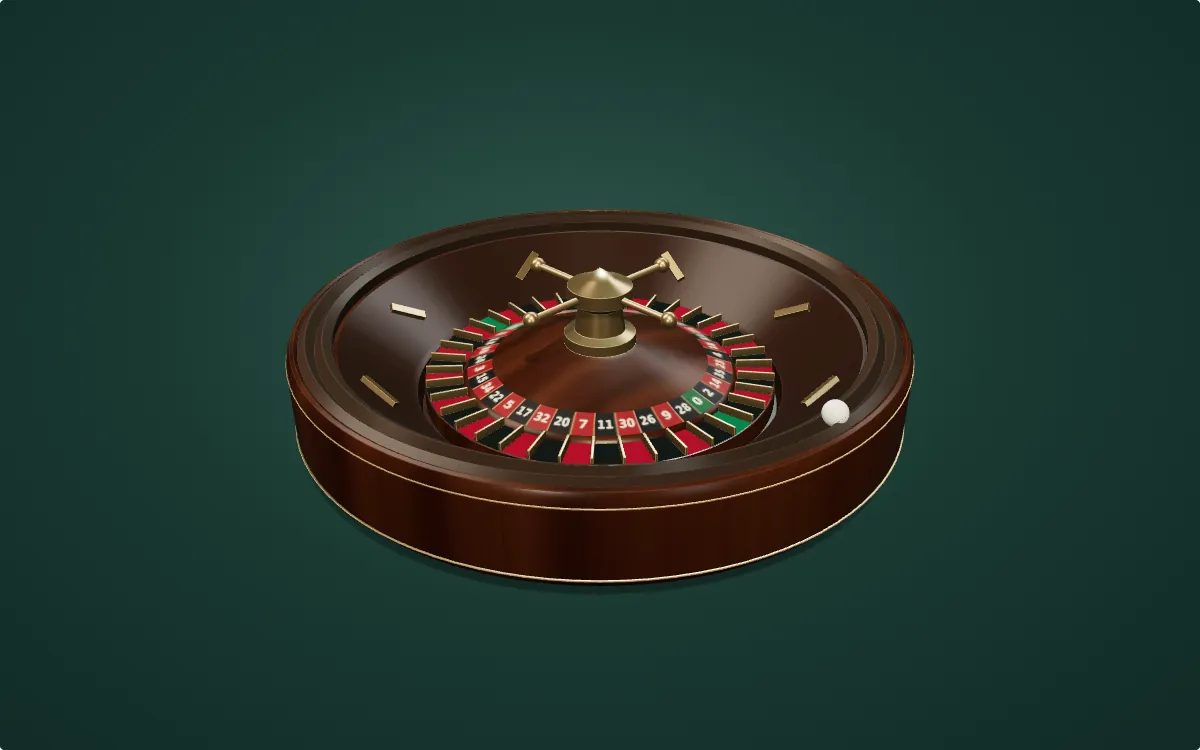
- The bowl. Everything starts with the bowl, the heavy outer body of the wheel that never turns. It carries the ball track along its upper edge and holds the spinning Rotor in its center. Because the bowl stays put, every round happens inside the same fixed frame: the dealer turns the rotor and releases the ball, while the bowl simply keeps the whole mechanism steady.
- The ball track. Around the top of the bowl runs a smooth groove called the ball track. The dealer sends the ball along it, traveling against the direction in which the Rotor turns. For a while the ball circles fast and high; once it slows, it can no longer hold the outer edge and slides down towards the Deflectors and the rotor.
- The deflectors. On the sloping band between the ball track and the Rotor sit small metal pieces known as Deflectors. They are fixed to the bowl, so they never turn. When the falling ball strikes one, it is knocked off its line and its path becomes much harder to predict. A single knock late in the descent can send it to a very different part of the wheel.
- The rotor. The Rotor is the turning center of the wheel, and it carries every numbered pocket. Before each round the dealer sets it spinning in one direction, then sends the ball around the track in the other. The two movements run against each other until the ball loses speed, leaves the track and drops down onto the rotor.
- 38 pockets. Brass dividers split the edge of the rotor into 38 pockets. Thirty-six of them hold the numbers 1 to 36, shared evenly between 18 red and 18 black. The other two are green: the single 0 and the Double zero, marked 00. Red and black alternate all the way round, and the two green pockets sit opposite each other. That second zero lifts the House edge to 5.26%.
- The number ring. The Number ring does not count upwards. Reading clockwise from the green 0, it runs 28, 9, 26, 30, 11, 7, 20, 32, 17, 5, 22, 34, 15, 3, 24, 36, 13, 1, then the green 00, then 27, 10, 25, 29, 12, 8, 19, 31, 18, 6, 21, 33, 16, 4, 23, 35, 14 and 2, which leads back to 0.
- The turret. At the very center stands the turret, a cross-shaped brass handle fixed to the Rotor. The dealer takes hold of it to set the rotor turning, then launches the ball along the outer track the other way. Those two actions together produce the familiar picture of ball and wheel racing in opposite directions.
- The ball in motion. With the rotor turning one way and the ball the other, the ball gradually loses speed. It drops from the track, may strike the Deflectors, and bounces across the pockets before settling. Only when it rests in a single pocket is the round decided. On this wheel, each of the 38 pockets is equally likely to catch it.
- Every part, pulled apart. This exploded view lifts the parts apart, from the outside in: the bowl, the ball track, the Deflectors, the Rotor, the 38 pockets, the Number ring, the turret and the ball. The bowl and the slope stay fixed, while the rotor, pockets, ring and turret turn together as one unit and the ball follows its own path.
- Explore for yourself. Drag to turn the wheel and zoom in on the Rotor, the Deflectors and the Number ring. Find the green 00 opposite the 0: that extra pocket is what changes the odds. A single number still pays 35 to 1, but with 38 pockets instead of 37 the House edge rises from 2.70% to 5.26% on almost every bet.
As you replay it, watch where the ball first touches the sloping wall and how far it travels after a deflector strike. That distance is why nobody at the table can call the pocket by eye. If any of the part names feel unfamiliar, the roulette terms glossary defines rotor, fret, canoe and the rest in one place.
Single Zero, Double Zero, Triple Zero: Are All Roulette Wheels the Same?
Not all wheels are built alike. The European and French wheel has 37 pockets with a single green 0 and its own order, starting 0, 32, 15, 19 clockwise. The payouts are identical to the American table, so the single extra pocket is the entire difference in price. Your average cost drops from 5.26% to 2.70% on every bet.
In dollars, $100 wagered on an American table loses $5.26 on average, against $2.70 on a single zero table. French rules such as La Partage halve the even-money cost again to $1.35. Given the choice at equal stakes, the single zero wheel is plainly cheaper. The American vs European roulette comparison sets out every bet side by side.
Some Las Vegas pits add a third green pocket. A triple zero roulette wheel carries 0, 00 and 000, so 39 pockets, while a single number still pays 35 to 1. Paying back 36 units on 39 pockets leaves an edge of 3 divided by 39, or 7.69%, the priciest standard wheel you are likely to see.
The European roulette wheel number sequence
The European roulette wheel, the single zero wheel, runs clockwise from 0, 32, 15, 19, 4, 21, 2, 25, 17, 34, 6, 27, 13, 36, 11, 30, 8, 23, 10, 5, 24, 16, 33, 1, 20, 14, 31, 9, 22, 18, 29, 7, 28, 12, 35, 3, 26. Red and black still alternate.
Casino Roulette Wheels: Who Builds Them and How They Are Checked
Casino roulette wheels are precision furniture rather than toys. Makers such as TCS John Huxley and Cammegh build them from hardwood and metal with tight tolerances, because a fraction of a degree of tilt can favor one section of the rotor. The weight and rigid build help the wheel stay level from one spin to the next.
Regulators such as the Nevada Gaming Control Board and the New Jersey Division of Gaming Enforcement set the rules casino games follow in their states, and casinos level and inspect wheels routinely. Modern wheels can log every result, which makes a biased pocket easier to spot. The is roulette rigged page covers the signs of an unfair one.
Digital and virtual roulette wheels
Digital wheels come in two kinds. An electronic table may use a real wheel with an automatic ball launcher. A roulette wheel simulator on a screen has no ball at all: software picks the pocket. Either way, the pocket count sets the price. The free roulette page covers practice on both wheel types.
The Roulette Wheel Layout versus the Table Layout
One point confuses new players most. The wheel and the betting cloth show the same numbers in completely different arrangements. The roulette wheel layout scatters them for randomness, while the felt lays them out in three tidy columns from 1 to 36, with 0 and 00 at the head. You bet on the cloth and the wheel decides.
A column on the cloth, scattered on the wheel
A chip in a 2 to 1 box at the end of a column: 2, 5, 8 and on to 35.
- Covers
- 12 of 38
- Pays
- 2 to 1
- Wins per 100 spins
- 31.6
- House edge
- 5.26%
Neighbors on the felt are strangers on the rotor. The 17 and 18 sit side by side on the cloth and share a split bet, yet on the wheel they face each other from opposite sides of the rotor. The roulette table layout page maps every box, and the how to play roulette guide shows the order of a round.
Next time you sit down, glance at the wheel before you look at the felt. Find the 0, then follow the rim until you locate the 00 directly across from it. If both green pockets are there, you are at a double zero table paying 5.26% on every bet, and a single zero wheel nearby is worth asking about.