
French roulette rules at a glance
French roulette rules start from the single-zero wheel: 37 pockets, 0 plus 1 to 36, in the same order as the European wheel. Every payout is standard, 35 to 1 on a single number down to 1 to 1 on red. The one change is what happens to even-money chips when 0 lands, and that is where the edge drops.
Without that rule, a single-zero wheel charges 2.70% on every bet: 36 units paid on a bet that faces 37 pockets. The French rule returns half of the even-money loss on zero, so those bets cost half as much. Straight ups, splits, dozens and columns stay at 2.70%. Only the six even-money boxes get the discount.
The cloth and its French labels
A traditional French layout uses French words for the outside boxes. Rouge and Noir mean red and black. Pair and Impair mean even and odd. Manque covers 1-18 and Passe covers 19-36. The dozens are often marked P12, M12 and D12, for first, middle and last. The roulette terms glossary lists them all.
What does roulette mean in French?
Roulette is French for little wheel, a diminutive of roue, the word for wheel. Most of the game’s vocabulary arrived with it: the word croupier and calls such as rien ne va plus, meaning no more bets. At a US table the dealer will usually say it in English, but the French terms still turn up on single-zero cloths.
The French roulette table: what you see when you sit down
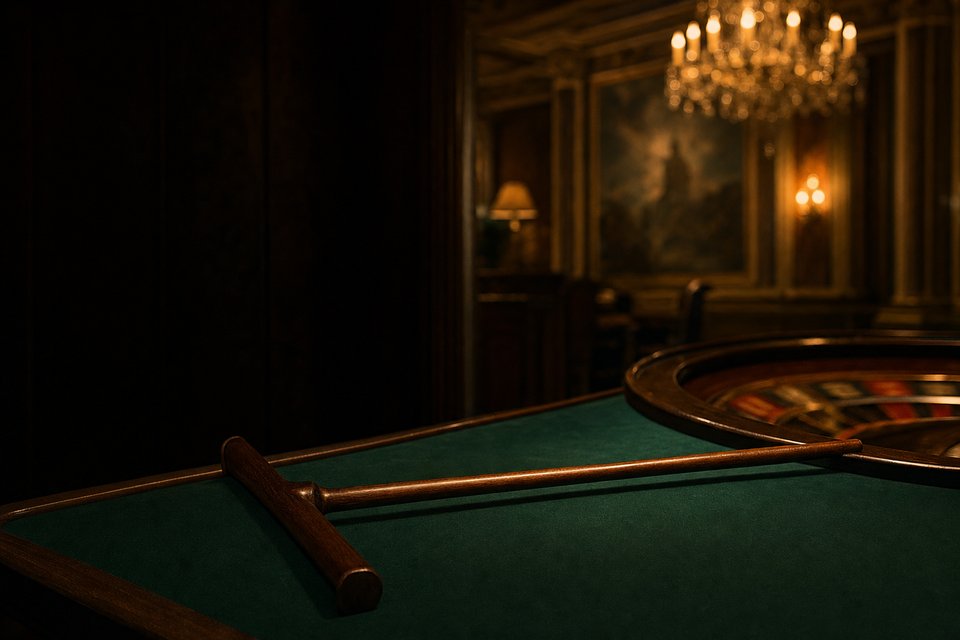
A French roulette table differs from an American one at a glance. In the classic casino layout the wheel sits in the middle with a betting cloth on each side, worked by several croupiers with rakes. Smaller tables put the wheel at one end, like the American game, and add the racetrack.
Another difference is the chips. Traditional French tables often play with cash-value chips, while a US table hands each player a stack of color chips that only work at that table. Wherever you sit, the rules for placing bets are the same: chips go down while the ball circles and stop at the call.
La Partage roulette: half back on zero
La Partage roulette works like this. You put $20 on red and the ball lands on 0. On an American or European table the chip is swept. Under La Partage the dealer takes $10 and hands $10 back. Nothing changes on any other spin: red still pays 1 to 1 when it wins and loses in full on black.
Why does this halve the edge? On a single-zero wheel, the only way an even-money bet loses money over time is the zero. La Partage cuts the loss on zero in half, so the long-run cost drops by half too: 2.70% becomes 1.35%. That is $1.35 per $100 wagered, the lowest price on any standard roulette table.
En Prison roulette: the chip waits a spin
En Prison roulette handles the zero differently. Your even-money chip is not split; it is held on the cloth, often marked with a small token, for one more spin. If the next spin wins your bet, the chip is released back to you with no added win. If it loses, the dealer takes it. Then play continues as normal.
The long-run arithmetic puts En Prison close to La Partage. Where a held chip stays imprisoned through repeat zeros, the even-money edge is exactly 1.35%; where a second zero simply takes it, the edge is about 1.39%. Some players prefer En Prison because the chip can return whole. Others like La Partage because the half comes back at once.
Which tables use which rule
La Partage is the version most often described for French tables, and En Prison appears in some European casinos. Either way, the sign at the table or the dealer will confirm it. If neither rule is mentioned, assume you are on a plain single-zero table charging 2.70% on everything, and price your bets on that basis.
The United States has its own echo of La Partage. New Jersey’s rules let an Atlantic City casino return half of a red, black, odd, even, high or low bet when the ball finds 0 or 00, at the casino’s option and with a notice at the table. On a double-zero wheel that halves the even-money cost to 2.63%.
French roulette odds against the other wheels
The French discount only means something next to the alternatives. Read the table below and compare the even-money row across the three wheels: 5.26% on American, 2.70% on European, 1.35% on French. Then look at the other rows, where European and French match exactly. The chance of each bet winning is identical on the two single-zero tables.
Chance per spin · house edge
| Bet | American | European | French |
|---|---|---|---|
| Straight up | 2.63% · 5.26% | 2.70% · 2.70% | 2.70% · 2.70% |
| Split | 5.26% · 5.26% | 5.41% · 2.70% | 5.41% · 2.70% |
| Street | 7.89% · 5.26% | 8.11% · 2.70% | 8.11% · 2.70% |
| Corner | 10.53% · 5.26% | 10.81% · 2.70% | 10.81% · 2.70% |
| Top line (0-00-1-2-3) | 13.16% · 7.89% | — | — |
| First four (0-1-2-3) | — | 10.81% · 2.70% | 10.81% · 2.70% |
| Six line | 15.79% · 5.26% | 16.22% · 2.70% | 16.22% · 2.70% |
| Dozen | 31.58% · 5.26% | 32.43% · 2.70% | 32.43% · 2.70% |
| Column | 31.58% · 5.26% | 32.43% · 2.70% | 32.43% · 2.70% |
| Red/black, odd/even, 1-18/19-36 | 47.37% · 5.26% | 48.65% · 2.70% | 48.65% · 1.35% |
Each cell shows the chance that the bet wins on one spin, then the share of every dollar wagered that the house keeps over time. A dash means the bet is not on that cloth.
In dollars the gap is plain. A thousand dollars staked on red costs about $52.60 on an American wheel, $27 on a European one and $13.50 on a French one, on average. Same chips, nearly four times the cost. The American vs European roulette page compares the two main wheels in more detail.
The chance of winning does not change
La Partage and En Prison do not make red win more often. On a single-zero wheel red still lands 18 times in 37, or 48.65% of the time. What changes is how much you lose on the one pocket where nobody wins. The payout chart on roulette payouts shows the full single-zero figures.
La Partage over 1,000 spins
Pick a bet and a wheel. One chip goes on it every spin, on a fair wheel. Watch the running total.
- Spins
- 0
- Wins (expected)
- 0
- Chips up or down
- 0
- Longest losing run
- 0
Short runs swing both ways. Over many spins the line drifts toward the dashed one, the average loss the house edge sets, because every bet is paid as if the green pockets were not there.
Racetrack roulette and the call bets
Racetrack roulette is the oval betting area printed beside the main cloth on many single-zero tables. It shows the numbers in wheel order, not in the grid order of the layout, so you can bet whole sections of the rotor at once. You call the bet, the dealer places your chips, and the bet covers that arc of the wheel.
The three classic call bets split the single-zero wheel into three sections that together use every pocket once. They follow the pocket order, not the grid. Clockwise from zero the rotor runs as below, and the roulette wheel page draws it as a ring. Mark where 22, 27 and 33 fall: 0-32-15-19-4-21-2-25-17-34-6-27-13-36-11-30-8-23-10-5-24-16-33-1-20-14-31-9-22-18-29-7-28-12-35-3-26.
Voisins du Zéro: the neighbors of zero
Voisins du Zéro covers the 17 numbers from 22 round to 25, with 0 near the middle. In wheel order: 22, 18, 29, 7, 28, 12, 35, 3, 26, 0, 32, 15, 19, 4, 21, 2 and 25. Seventeen pockets out of 37 is about 45.9% of the wheel, so this section is hit almost half the time.
Tiers du Cylindre and Orphelins
Tiers du Cylindre covers the 12 numbers directly opposite zero, from 27 to 33: 27, 13, 36, 11, 30, 8, 23, 10, 5, 24, 16 and 33. Twelve of 37 is about 32.4% of the wheel. Orphelins takes the 8 numbers left: 17, 34 and 6 in one arc, then 1, 20, 14, 31 and 9 in another.
Call bets are built from ordinary splits and straight ups, so they carry no special price. Each piece costs 2.70% like any other single-zero bet, and the La Partage discount does not apply because none of the pieces is an even-money bet. A call bet is a faster way to place chips, not a cheaper one.
Is French roulette worth seeking out?
If you bet red, black, odd, even, low or high, the answer is a plain yes. French roulette charges half the European price on those bets and about a quarter of the American price. No staking plan can do that; only the rules can. The roulette strategy page shows why choosing the wheel matters more than any system.
For inside bets, the case is narrower. A straight up on 17 costs 2.70% on both single-zero tables, so a European wheel is just as good. In the US, French rules are uncommon and usually found, if at all, in high-limit rooms. Before you buy in, check the sign: one zero, and half back on even money?