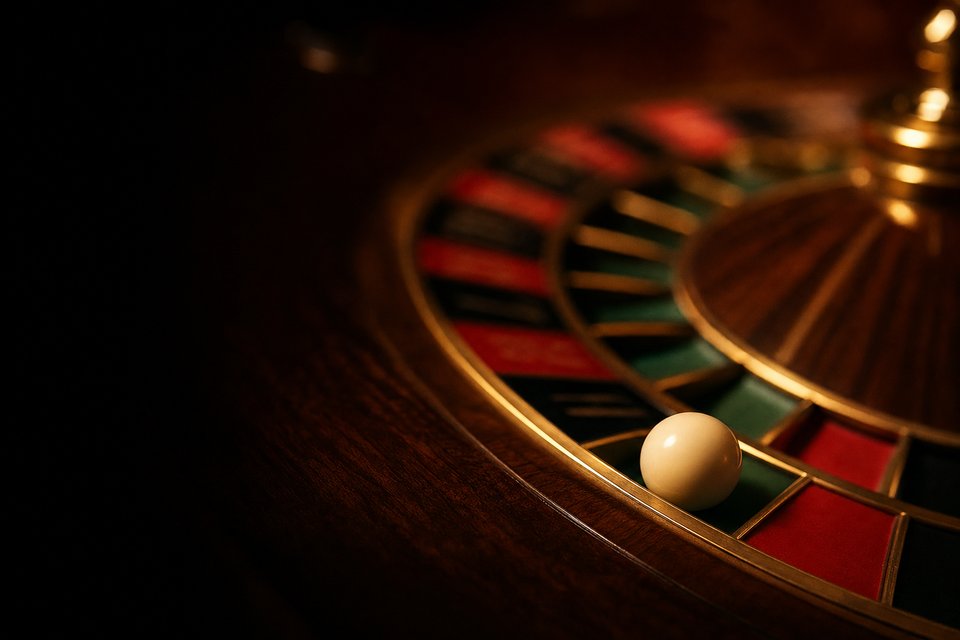

Green in roulette: the two pockets on the American wheel
An American wheel has 38 pockets: 1 to 36 in red and black, plus 0 and 00 in green. The two greens sit directly opposite each other on the rotor, so the ball spends no more time near one than the other. On the table they sit at the top of the cloth, above the numbers 1, 2 and 3.
A single-zero wheel drops the 00 and keeps only one green pocket, which gives 37 pockets in all. That one missing pocket is the whole difference between the American and European prices. The roulette wheel page traces the full pocket order, and you can see both greens spaced half a rotor apart there.
Green roulette payout: what each green bet pays
The payout on green in roulette depends on how many numbers you cover. Every bet is paid as if the wheel had only 36 pockets, so the green pockets themselves are paid at the same rate as any number. They earn no premium, because they are not rarer: each green pocket comes up as often as 17 or 32.
| Green bet | Numbers covered | Pays | American chance |
|---|---|---|---|
| Straight up on 0 or 00 | 1 | 35 to 1 | 2.63% |
| 0-00 split | 2 | 17 to 1 | 5.26% |
| Trio 0-1-2, 0-00-2 or 00-2-3 | 3 | 11 to 1 | 7.89% |
| Top line 0-00-1-2-3 | 5 | 6 to 1 | 13.16% |
What 00 pays and what 0 pays
What does 00 pay in roulette? The same as 0, which is 35 to 1 on a straight-up chip. A $10 chip on 00 that wins comes back as $360, the $350 win plus your chip. What does 0 pay in roulette? Also 35 to 1, on every wheel, whether the table has one green pocket or two.
So how much is green on roulette worth if you cover both? Put one chip on the 0-00 split and it pays 17 to 1. Put one chip on each zero and the winner pays 35 while the other chip is lost, a net of 34 for two chips. The two routes land on the same result.
$100 on green: the payout in dollars
Put $100 on green in roulette as a straight-up chip on 0 and a hit pays $3,500, with your $100 back for $3,600 in total. Split the same $100 as $50 on 0 and $50 on 00 and a hit on either pays $1,750 on the winner while the other $50 is lost, a net gain of $1,700.
The $100 on the 0-00 split gives the same net: 17 to 1 pays $1,700. What changes is how often you see a win. The single chip on 0 wins about once in 38 spins, while either version covering both zeros wins about once in 19. Over many spins all three lose $5.26 per $100 wagered.
Payout drill
The ball drops into 00. On the cloth: 2 chips on straight up on 00, 1 chip on split 0-00, 1 chip on top line (0-00-1-2-3) and 5 chips on red. How many chips does the dealer pay out, not counting the stakes that stay in place?
straight up on 00: 2 × 35 = 70. split 0-00: 1 × 17 = 17. top line (0-00-1-2-3): 1 × 6 = 6. red loses 5. The dealer takes 5 losing chips first. Payout: 93 chips.
The drill puts four bets on the cloth at once: two chips straight up on 00, one on the 0-00 split, one on the top line and five on red. The ball has dropped into 00. Work out which bets win and which are swept, total the net result, then check your answer against the card before reading on.
Odds of hitting green in roulette
Two green pockets out of 38 means green lands 5.26% of the time on an American wheel, or once in 19 spins on average. Either single pocket alone lands 2.63% of the time. On a European wheel the one green pocket comes up 2.70% of the time. That sounds rare. Over an evening of play, it is not.
Payout drill
The ball drops into 0. On the cloth: 3 chips on split 0-00 and 2 chips on red. How many chips does the dealer pay out, not counting the stakes that stay in place?
split 0-00: 3 × 17 = 51. red loses 2. The dealer takes 2 losing chips first. Payout: 51 chips.
Long dry spells are normal, though. The chance that neither green pocket shows in 38 straight American spins is 36/38 multiplied by itself 38 times, which works out to roughly 12.8%. So roughly one stretch of 38 spins in eight shows no green at all, and none of that changes the next spin.
How often does green hit in roulette over a session?
Over 100 spins on an American wheel you would expect green about 5.26 times, and over 380 spins about 20 times. Real sessions scatter widely around those figures: three greens in ten spins or none in sixty both happen without anything being wrong with the wheel. Each spin is a fresh 2-in-38 draw.
Wait for green: 1,000 spins
Pick a bet. One chip goes on it every spin, on a fair American wheel with 38 pockets. Watch the running total.
- Spins
- 0
- Wins (expected)
- 0
- Chips up or down
- 0
- Longest losing run
- 0
Short runs swing both ways. Over many spins the line drifts toward the dashed one, the average loss the house edge sets, because every bet is paid as if the green pockets were not there.
The gambler’s fallacy on green
A run without green does not make green due. The ball has no memory and the rotor has no ledger, so the chance on the next spin stays exactly 5.26%. Players who raise their stake on green after a long gap are paying the same price for a bigger swing, and nothing else has moved.
What happens to outside bets when green hits
Here is where green in roulette costs every player at the table, not only those who bet on it. Red, black, odd, even, 1-18, 19-36, every dozen and every column lose when 0 or 00 lands. Zero is not counted as even. That single rule is why a red chip wins 47.37% of the time instead of half.
The table below compares the chance and the house edge for each bet family on all three wheels. Read the even-money row first, then look at how the French column differs from the European one. That difference is the only place where green is softened for outside bets, and it applies only on a French table.
Chance per spin · house edge
| Bet | American | European | French |
|---|---|---|---|
| Straight up | 2.63% · 5.26% | 2.70% · 2.70% | 2.70% · 2.70% |
| Split | 5.26% · 5.26% | 5.41% · 2.70% | 5.41% · 2.70% |
| Street | 7.89% · 5.26% | 8.11% · 2.70% | 8.11% · 2.70% |
| Corner | 10.53% · 5.26% | 10.81% · 2.70% | 10.81% · 2.70% |
| Top line (0-00-1-2-3) | 13.16% · 7.89% | — | — |
| First four (0-1-2-3) | — | 10.81% · 2.70% | 10.81% · 2.70% |
| Six line | 15.79% · 5.26% | 16.22% · 2.70% | 16.22% · 2.70% |
| Dozen | 31.58% · 5.26% | 32.43% · 2.70% | 32.43% · 2.70% |
| Column | 31.58% · 5.26% | 32.43% · 2.70% | 32.43% · 2.70% |
| Red/black, odd/even, 1-18/19-36 | 47.37% · 5.26% | 48.65% · 2.70% | 48.65% · 1.35% |
Each cell shows the chance that the bet wins on one spin, then the share of every dollar wagered that the house keeps over time. A dash means the bet is not on that cloth.
La Partage and En Prison soften the blow
On a French table, an even-money chip that meets the zero is not simply swept. Under La Partage you get half of it back; under En Prison it stays on the cloth for one more spin. Either rule cuts the even-money edge from 2.70% to 1.35%. The French roulette page covers both rules in detail.
What happens when you land on green at an American table
When the ball lands on green, the dealer places the dolly on 0 or 00 and sweeps every losing chip, often most of the layout. Anyone holding the winning green number, the 0-00 split, a trio touching that zero or the top line is paid next. If you had red, your chip is gone; it does not push.
That is the practical answer to how often green hurts you. With red, black or any other even-money bet on an American wheel, green beats you 2 spins in 38 on top of your normal losses to the other color. Those two pockets are the entire 5.26% edge you pay on that bet.
Why green is on a roulette wheel at all
Without green in roulette, a wheel paying 35 to 1 on 36 numbers would hand back every dollar it took, on average. The green pockets are the margin. They are added to the wheel but left out of the payouts, so 36 units are paid on a bet that faces 38 pockets. That gap of two pockets is the 5.26%.
The single zero is commonly credited to François and Louis Blanc at Bad Homburg in the nineteenth century, and the single-zero game later became the standard in Monte Carlo. American casinos kept the double zero. The cost difference is plain arithmetic, and the American vs European roulette page sets the two side by side.
Should you bet on green in roulette?
Betting on green in roulette carries the same 5.26% edge as any other American straight-up number, and a 2.70% edge on a single-zero wheel. It is neither a smart play nor a sucker bet. It is a high-variance bet: you lose most spins and occasionally win big. The roulette bets page lays out every alternative at the same price.
The top line is the exception worth remembering. Covering 0, 00, 1, 2 and 3 with one chip costs 7.89%, about $7.89 per $100 wagered, against $5.26 on any other American bet. If you want both zeros covered, the split or two straight-up chips do it cheaper. The full chart sits on roulette payouts.
Progressions on green
Some players double their green stake after every miss. A long gap between greens makes that doubling hit the table maximum quickly. The roulette strategy page shows why no staking plan beats the edge. Keep a fixed budget, and when the dealer places the dolly on a green pocket, watch which outside chips leave the cloth first.